
Beyond the guidebook
The most memorable travel experiences rarely come from the top-ten tourist lists. They come from authentic moments: a family-run restaurant, a neighborhood festival, a conversation with a local. Finding these takes a little effort and a lot of curiosity.
Authentic experiences let you understand how people actually live, not how tourism markets a place. They're also usually cheaper and far more rewarding.
How to find the real local life
- Explore residential neighborhoods, not just tourist centers.
- Eat where locals eat — busy spots with locals and no English menu are good signs.
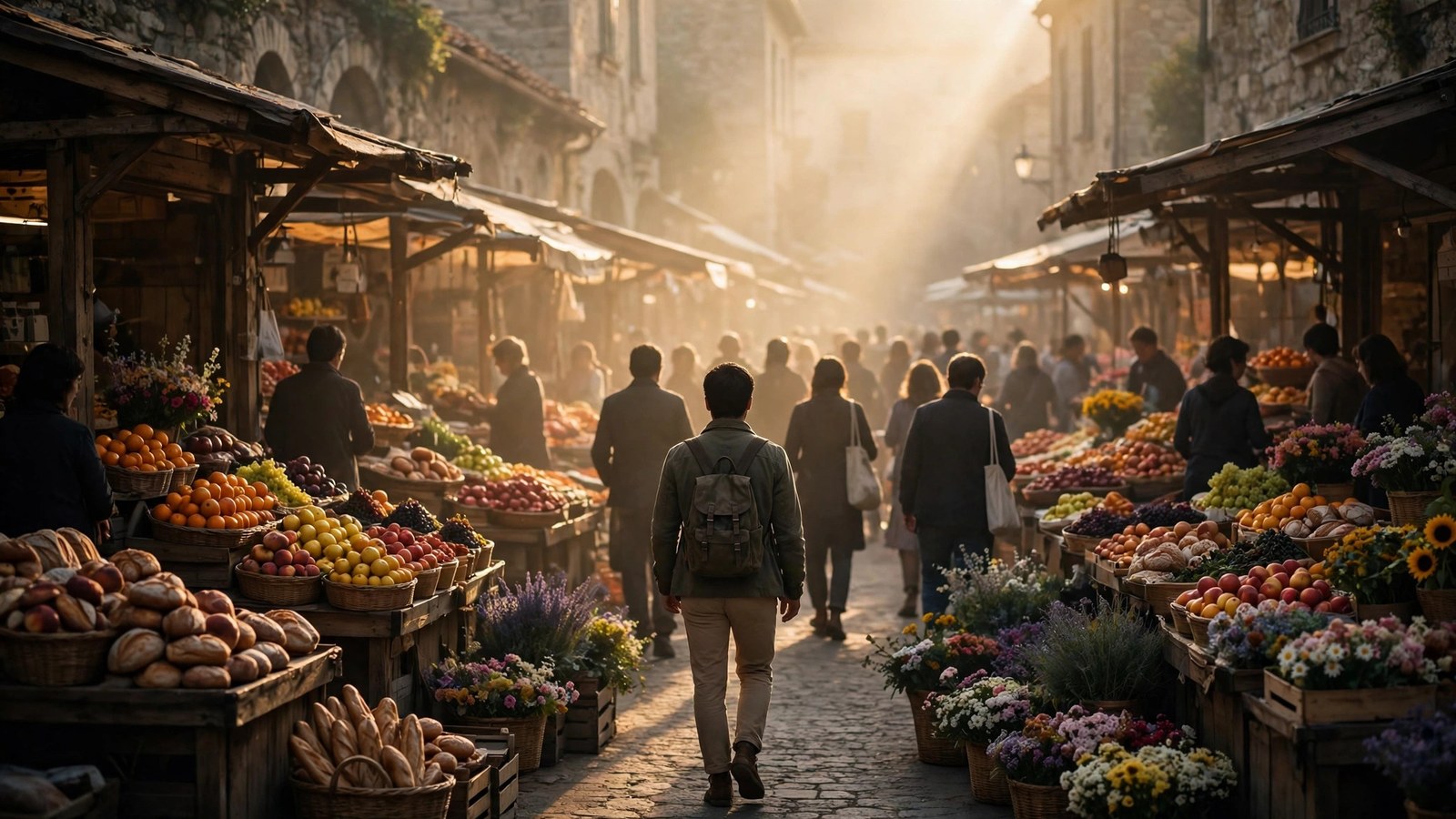
- Visit local markets for food, crafts, and daily life.
- Ask locals for recommendations — start with our Conversation Starter Generator.
- Use public transit to see how the city really moves.
- Attend community events, festivals, and religious or cultural celebrations.
Connect respectfully
Authentic travel means engaging with people as people, not as photo opportunities or service providers. Learn a few phrases, show genuine interest, and respect that you're a guest in their daily life.
Reading our Country Guides beforehand helps you understand local customs so you can connect comfortably. The deeper you engage, the more a place reveals itself.
Read the city like a local
Tourist infrastructure is designed to be legible: signs in English, menus with pictures, staff trained to serve visitors. The real city is one layer deeper, and it rewards a different way of looking. Start with the rhythm of the day. In many Mediterranean cities, mornings belong to locals at café counters and evenings to the long passeggiata; in Tokyo, the salaryman rush at 8 a.m. and the quiet of residential alleys at dusk tell you more than any landmark. Notice where people buy groceries, where teenagers hang out after school, which bakery has a line at 7 a.m. — these are the coordinates of daily life.
A practical technique: pick one neighborhood and walk it at three different times of day. Morning shows you the working city — deliveries, school runs, shopkeepers opening shutters. Midday shows you the eating city — follow office workers to lunch, not tour groups. Evening shows you the social city — plazas, parks, and food streets where residents actually spend their free time. Take the same walk twice and shopkeepers start recognizing you; by the third visit you are no longer quite a stranger.
Experiences worth seeking out
- Take a class taught by a local — cooking, pottery, dance, or a craft. You learn a skill and meet people in a natural, unhurried setting. Small-group classes beat large tour-operator workshops.
- Volunteer for a morning — beach cleanups, community gardens, and food banks exist in most cities and welcome short-term help. You contribute something real and meet residents who care about the place.
- Watch local sport the local way — a neighborhood football match, a sumo morning practice, a cricket game in a Mumbai park. The crowd's rituals are the culture.
- Shop at a morning market — go early, buy fruit, ask the vendor what's good this week. Market vendors are often the friendliest ambassadors of a city.
- Use local services — get a haircut, visit a public bathhouse or hammam, take a music lesson. Ordinary errands become cultural exchanges when you do them abroad.
Common mistakes that keep you in the tourist bubble
The biggest mistake is outsourcing every decision to an algorithm optimized for tourists: the top-ranked restaurant on a review app is, by definition, where other tourists go. Instead, triangulate — ask your guesthouse host where they eat on a day off, then ask the server there where they go for late-night food. Two hops from any tourist source usually lands you somewhere genuine.
Another trap is packing the schedule so tightly that spontaneity becomes impossible. Authentic moments are unplannable: the invitation to join a family barbecue, the festival you stumble into, the conversation that starts because you sat on the same park bench. Leave deliberate gaps — an unplanned afternoon is not wasted time, it is the space where the real trip happens.
Finally, beware the "authenticity performance" — experiences staged for visitors that wear local costume but run on a tourist script. Signs include aggressive upselling, a fixed photo routine, and an audience composed entirely of foreigners. Real local life is rarely trying to sell you anything.
A respectful traveler's checklist
- Learn 10–15 phrases in the local language before you arrive — greetings, thanks, and "this is delicious" open more doors than any guidebook. Our Language Helper covers the essentials.
- Read the Country Guide for your destination so you know basic etiquette around dress, tipping, and photography.
- Ask permission before photographing people, and accept "no" gracefully.
- Spend money locally — family-run guesthouses, neighborhood restaurants, and artisan shops keep your travel budget in the community.
- Keep a small notebook of recommendations from locals; it becomes a personalized guide no app can replicate.
Frequently asked questions about authentic travel
Is it disrespectful to visit residential neighborhoods? Not if you behave like a respectful guest: keep noise down, don't block streets for photos, and remember people live there. Wandering quietly, buying from local shops, and greeting people is welcome almost everywhere.
How do I find events that aren't aimed at tourists? Check community bulletin boards in cafés and libraries, local event listings in the native language (use a translation app), and ask hosts or coworkers where they go on weekends. University campuses often host public lectures, concerts, and exhibitions.
What if I don't speak the language? You can still connect — smiles, gestures, phrasebooks, and translation apps go a long way. But learning even a little of the language transforms the experience, because effort signals respect. Start with our guide to why learning a few words matters.
Slow down to see more
The single biggest predictor of authentic experiences is pace. Travelers who spend two weeks in one city invariably report deeper, more local experiences than those who spend two days in seven cities — not because the cities differ, but because time compounds. On day one you are a tourist; by day five the café owner knows your order; by day ten you have been invited somewhere no guidebook lists. Our guide to slow travel explores this in depth, but the principle is simple: depth beats breadth.
Practically, this means resisting the urge to "maximize" a trip. Choose fewer bases, stay longer in each, and let routine do the work — the same morning bakery, the same evening stroll. Routine is what turns a visitor into a temporary local, and temporary locals get the experiences tourists never see.
Document without exploiting
Keeping a travel journal — written, sketched, or photographed — deepens authentic travel because it forces attention. But document people with care: ask before photographing, share the photo with your subject when you can, and never treat someone's daily life as your content. The most respectful souvenir is a memory you earned through genuine interaction, not a snapshot taken without consent.
Bring it home
Authentic travel changes how you live afterward, if you let it. The traveler who learned to linger over coffee in Italy, to remove shoes without being asked in Japan, or to greet shopkeepers in France brings those small civilities home. Keep one habit from each trip — a recipe, a greeting ritual, a slower morning — and your daily life becomes a little more connected to the wider world. That is the real souvenir: not what you saw, but how you learned to see. For more on turning travel into lasting perspective, read our guide to cultural curiosity as a superpower.