
Short answer: Beyond surgery, hospitals deploy robots on the work that consumes their corridors: internal logistics (medication, specimens, linen, meals and waste), cleaning and disinfection, and pharmacy and laboratory automation. These systems — mobile delivery robots such as Aethon's TUG, clinical-workflow assistants of the kind Diligent Robotics builds, and automated pharmacy systems — succeed on unglamorous criteria: elevator integration, infection control, and whether the machine survives the hospital's busiest corridor at its busiest hour. The surgical side of hospital robotics is covered separately in our guide to surgical and medical robots.
Logistics: the hospital is a warehouse with patients
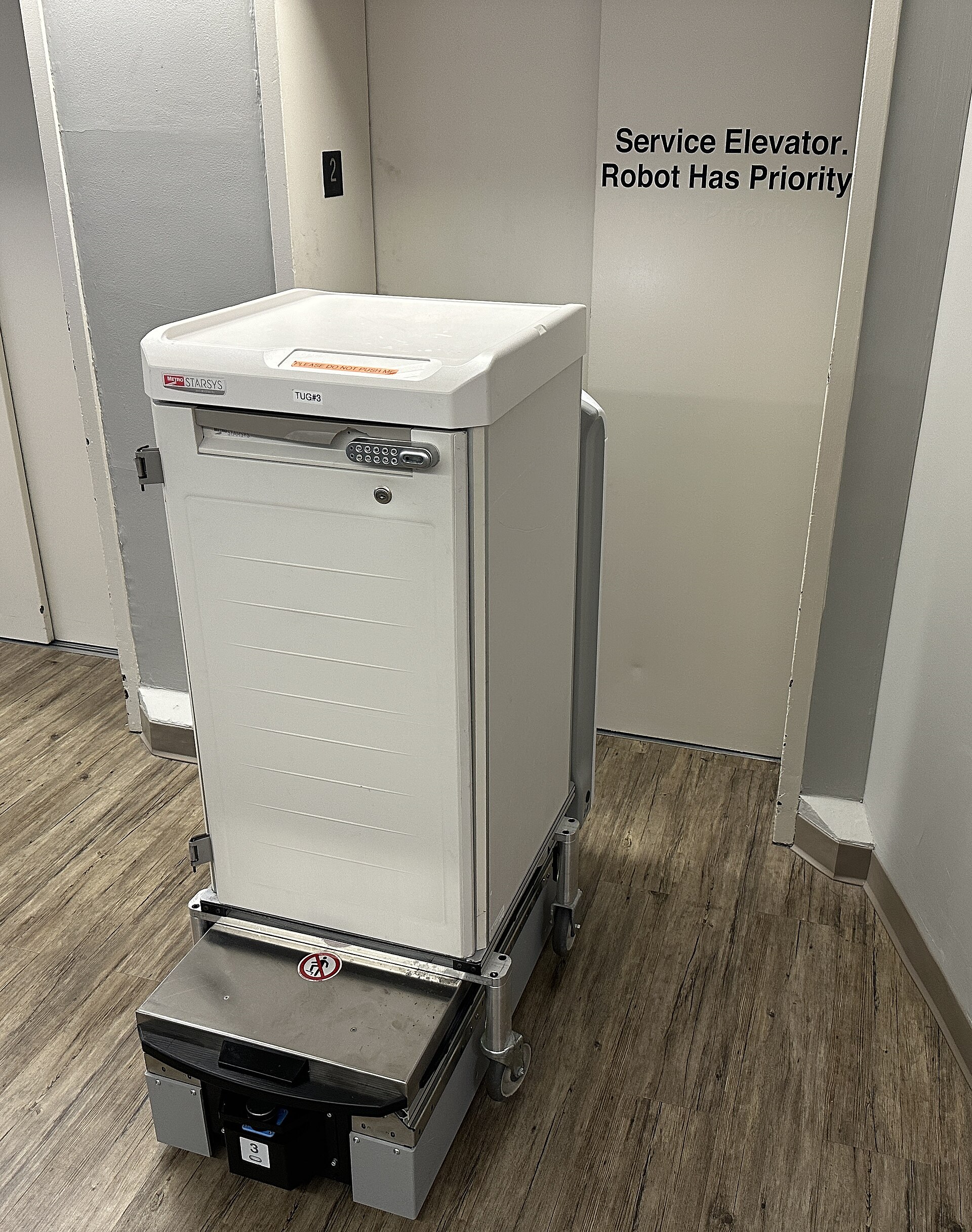
A hospital moves an extraordinary tonnage through its corridors — pharmacy items, laboratory specimens, sterile supplies, linen, meals, waste, documents and equipment — much of it carried by staff whose training is worth more than the carrying. Delivery robots take the predictable share of that traffic: scheduled runs between pharmacy, wards, laboratory and stores. The TUG pattern — a mobile base hauling carts or carrying a secure cabinet, calling lifts and opening doors through building integration — is the category's reference design. The evaluation questions are the building's, not the robot's: lift compatibility and priority rules, door hardware, corridor width at peak traffic, Wi-Fi dead zones, and the charging and staging space nobody remembered to allocate.
Security and chain of custody
Hospital cargo is not warehouse cargo. Medication runs require locked compartments, authenticated handover and an audit trail of who sent, carried and received. Specimens and blood products add labelling and timing discipline. Waste streams add segregation rules. Procurement should therefore treat the delivery robot as a participant in the hospital's medication and materials governance: access control per user, logged journeys, exception handling when a delivery is refused or a lift fails mid-route. A robot that carries beautifully but cannot prove what it carried will not pass a pharmacy committee — and should not.
Cleaning and disinfection machines
Floor-care robots scrub and vacuum the large, predictable areas — corridors, lobbies, canteens — increasingly at night, with coverage reports that environmental-services managers can audit. Disinfection robots, typically ultraviolet units, work in emptied rooms as an addition to manual terminal cleaning, under operating procedures set by infection-prevention teams. This article makes no efficacy claims for any disinfection technology: those belong to the hospital's own infection-control assessment and the regulator's authorisations. The procurement contribution is operational — room turnaround time, staff procedures, safety interlocks and how the machine fits the cleaning schedule it is meant to relieve.
Pharmacy and laboratory automation
Inside the pharmacy, automation takes the form of storage-and-retrieval systems, dispensing cabinets' robotic cousins, and packaging and labelling lines that reduce picking errors and free pharmacists for clinical work. In the laboratory, sample transport — by robot, by pneumatic tube or by both — and pre-analytical sorting connect reception to analysers. These are the systems evaluated in our guide to robots in pharmaceutical and lab automation, and they share this article's theme: in healthcare, the robot's value is measured in errors avoided and professional hours returned, and its acceptance runs through clinical governance rather than a facilities budget alone. The cross-sector service picture — hotels and retail as well as hospitals — is drawn in our guide to service robots in hotels, hospitals and retail.
Measuring whether it worked
Hospital robot projects should be judged on measures agreed before the first delivery run: porter and nursing hours released per week, deliveries completed without staff escort, failed or late deliveries per hundred journeys, and cleaning coverage actually achieved against the schedule. Baseline the manual process first — hospitals are often surprised by how much carrying their current system really does — and review the robot figures monthly for the first year, because the trend, not the launch week, is the evidence. A fleet whose unassisted-completion rate climbs as routes and doors are fixed is converging; one whose rate never moves has a building problem wearing a robot costume.
What hospital procurement must check
Beyond the clinical and logistical criteria, three checks decide hospital deployments. Infection control: the machine itself must be cleanable to the hospital's protocol, materials and seams included. Safety in shared space: corridors carry beds, drips, children and emergencies, and the robot's behaviour around all of them — yielding, announcing, never blocking an exit route — is a specification, not a hope. And operational ownership: a named hospital team owns charging, cleaning, exception handling and the supplier relationship, because a robot shared by everyone is maintained by no one. Hospitals that assign that owner get a colleague; hospitals that do not get a sculpture.
Frequently asked questions
What robots do hospitals use besides surgical robots?
Delivery robots for medication, specimens, linen, meals and waste; floor-cleaning and disinfection machines; and pharmacy and laboratory automation for storage, dispensing and sample handling. The value is in staff hours returned and errors avoided.
Why is elevator integration so important for hospital robots?
Hospital work is vertical: pharmacy, wards, laboratory and stores sit on different floors. A delivery robot must call lifts, ride them alone and follow agreed priority rules, or staff end up escorting it — and the labour saving evaporates.
What governance applies to robots carrying medication?
Locked compartments, authenticated handover and a logged chain of custody: who sent, carried and received, with exception handling for failed deliveries. The robot participates in the hospital's medication governance, not just its transport.
Who should own a hospital robot fleet inside the hospital?
A named operational team — responsible for charging, cleaning, exception handling and the supplier relationship. Deployments without an owner degrade quietly, whatever the machine's specifications.