
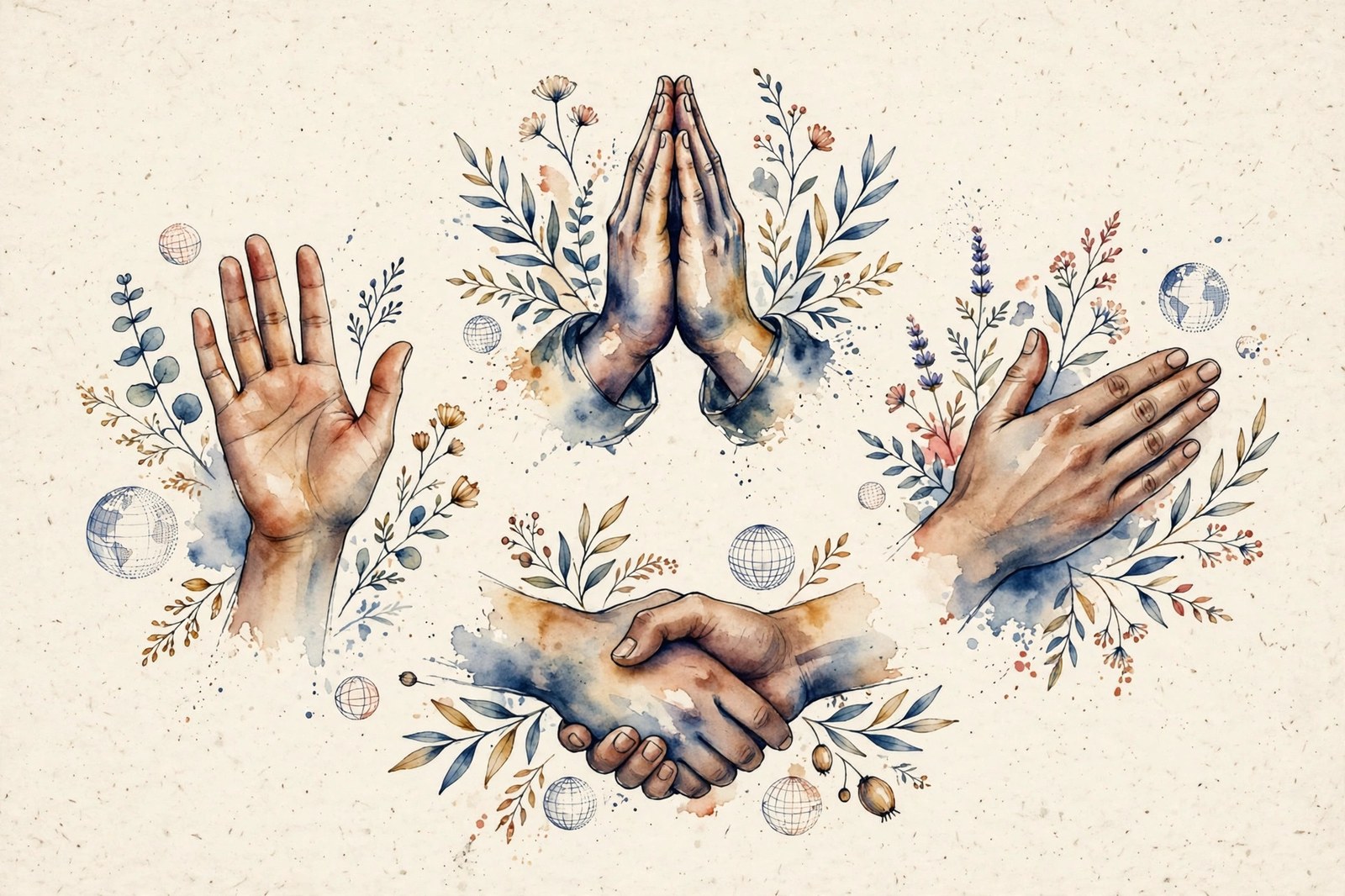
Your body speaks before you do
Communication is far more than words — gestures, eye contact, posture, and personal space all carry meaning. The catch: these signals mean different things in different cultures. A friendly gesture at home can be deeply offensive abroad.
Understanding nonverbal differences helps you avoid accidental insults and read others more accurately.
Key nonverbal differences
- Gestures — the 'OK' sign, thumbs up, and beckoning vary from positive to offensive by country.
- Eye contact — direct in the West, but a sign of disrespect toward elders in some cultures.
- Personal space — close in Latin and Middle Eastern cultures, wider in Northern Europe and East Asia.
- Touch — handshakes, hugs, and pats carry different weight and gender norms.
- Head movements — nodding doesn't mean 'yes' everywhere.
How to communicate respectfully
When unsure, keep gestures minimal and observe how locals interact. Mirror their level of eye contact, personal space, and physical contact. Watch their comfort and adjust accordingly.
Learn more in our Personal Space & Touch and Greetings Around the World lessons. Being mindful of body language shows deep cultural respect.
Gestures that change meaning at the border
Hands are the most treacherous part of cross-cultural communication because the same shape carries wildly different messages. The "OK" hand sign means "zero" or "worthless" in France, is vulgar in Brazil and parts of the Mediterranean, and is a cheerful "all good" in the United States. The thumbs-up is positive across much of the West but insulting in parts of West Asia and Australia. Beckoning someone with a curled index finger reads as calling a dog in the Philippines and is considered rude in Japan, where the palm-down wave is the polite form.
Even pointing deserves care: in many Southeast Asian and African cultures, pointing with the index finger is impolite — people gesture with the chin, the lips, or an open hand instead. And the left hand carries a taboo across much of the Middle East, South Asia, and Africa, where it is traditionally associated with bodily hygiene. Offer, receive, and eat with your right hand in these regions, even if you are left-handed; the effort is noticed and appreciated.
Reading faces, eyes, and space
Eye contact is a confidence signal in the United States, Germany, and much of Latin America — look away too much and you seem shifty. In Japan, Korea, and many Indigenous cultures, prolonged direct eye contact with elders or superiors signals defiance, not honesty; a softer, intermittent gaze shows respect. Neither is "correct" — they are different grammars of respect, and fluency means code-switching.
Smiling is not universal either. In the United States, strangers smile as a default courtesy. In Russia and parts of Central Asia, smiling at strangers can read as insincere or odd — smiles are reserved for genuine warmth. Travelers sometimes misread a neutral Russian expression as coldness when it is simply a different social default.
Personal space follows climate and culture more than you might expect. In Brazil, Saudi Arabia, and Italy, close conversation distance signals warmth; stepping back can feel like rejection. In Finland, Japan, and much of Northern Europe, a wider bubble signals respect; stepping in can feel aggressive. Watch the distance locals keep with each other — not with you — and match it.
Posture, head, and feet
Nodding does not mean "yes" everywhere. In Bulgaria and parts of Greece, a nod means "no" and a head-shake means "yes" — a reversal that has confused generations of visitors. In India, the famous head wobble can mean yes, maybe, or "I'm listening," depending on speed and context. When words and head movements conflict, trust the words and ask gently.
Feet are considered the lowest, least clean part of the body in Thailand, the Arab world, and much of South Asia. Showing the soles of your feet — by crossing your legs toward someone, or resting feet on furniture — is a genuine insult. Remove shoes where others do, and never step over food or a person.
Posture speaks too: upright and still in formal East Asian settings, relaxed and expansive in much of Latin America. When in doubt, mirror the room — sit as others sit, stand as others stand.
How to learn the local body language fast
- People-watch before you participate. Spend your first day observing: how do strangers greet? How close do friends stand? Imitation is the sincerest form of cultural research.
- Ask a local directly. "Is there any gesture I should avoid here?" is a question people love answering — it shows exactly the respect you want to convey. Try our Conversation Starter Generator for natural ways to open such chats.
- Study the country guide. Our Country Guides and Greetings Around the World lesson cover the essentials per destination.
- Default to stillness. When uncertain, keep gestures small and hands quiet. A calm, attentive presence is polite in every culture on earth.
Digital body language
Nonverbal communication has moved online, and the cultural grammar followed. Response time carries meaning: in Brazil and much of Latin America, a fast reply signals warmth; in Japan or Germany, a considered delay signals thoughtfulness, not coldness. Emoji use varies enormously — effusive in the Americas and Southeast Asia, restrained in Northern Europe and East Asia, where a single carefully chosen sticker may carry more weight than a string of smileys.
Video-call norms differ too. Camera-on is expected in many Latin and Middle Eastern business cultures as a sign of engagement; camera-off is more accepted in parts of Europe where privacy is prized. When in doubt, mirror your counterpart: if their camera is on, turn yours on. And remember that silence on a call reads differently across cultures — in Finland or Japan, a pause means thinking; in the United States or Brazil, it can feel like disconnection. Name the norm when working across cultures: "I notice we handle pauses differently — let's make space for both styles."
When you get it wrong anyway
You will — everyone does. The recovery matters more than the mistake. A simple, warm acknowledgment works in nearly every culture: "I'm still learning your customs — thank you for your patience." Avoid over-apologizing, which can make a small moment uncomfortably large, and avoid freezing, which reads as indifference. Most people are generous toward visible effort; what offends is not the error but the attitude that no adjustment is needed. Our guide to handling cultural misunderstandings walks through graceful recovery step by step.
A traveler's nonverbal phrasebook
Think of body language as a phrasebook you study before each trip. Before you go, learn five things: the local greeting (bow? handshake? cheek kiss? and how many?), the norms for eye contact with strangers versus elders, the polite distance for conversation, any gestures to avoid, and the rules about touch, shoes, and the left hand. Five facts, ten minutes of reading in our Country Guides — and you will move through a new culture with noticeably more grace. The goal is not perfection; it is the visible effort that tells people you respect their world enough to learn its language, spoken and unspoken alike.
Finally, extend the same grace to others that you hope to receive. When a fellow traveler commits a nonverbal faux pas near you, assume ignorance rather than disrespect — exactly as you hope locals will assume about you. Cultural fluency is a two-way street, and generosity is its common language.