
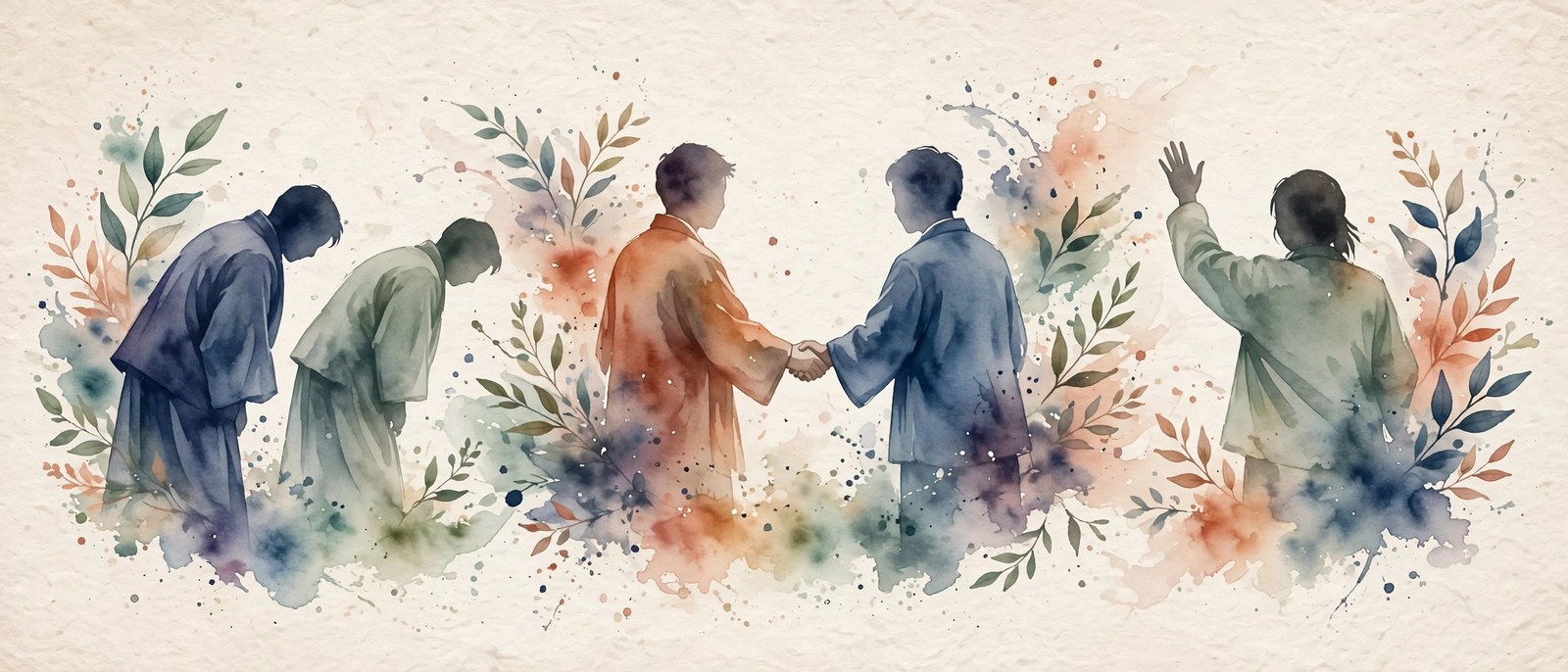
Why greetings matter
A greeting is your first impression, and getting it right signals respect and cultural awareness. The wrong greeting isn't fatal — effort is always appreciated — but knowing the norm helps you start on the right foot.
Common greeting styles
Handshakes dominate the West and business worldwide. Bows are traditional in Japan and Korea. Cheek kisses are common in France, Italy, Spain, and Latin America (the number varies!). The wai in Thailand and namaste in India use pressed palms.
Practical tips
When unsure, a warm smile and a slight nod is universally safe. Follow the other person's lead. In mixed settings, a handshake is a reliable default. Pay attention to gender norms, which vary by culture and religion.
Scenario: the cheek-kiss confusion
Sophie, an American exchange student in Paris, meets her host family. The mother leans in — Sophie leans in — and then neither knows whether to do one cheek, two, or switch sides. They bonk foreheads, laugh awkwardly, and Sophie spends the evening replaying it. (In Paris it's typically two; in parts of southern France it can be three or four; in some Latin American contexts it's one.)
What to do instead: let the local lead, every time. Offer a warm smile, lean in slightly, and mirror: they choose the side, you follow; they stop, you stop. If you're truly lost, a friendly “I'm still learning the local greeting — show me?” turns the awkwardness into a bonding moment. People love teaching their customs to someone who genuinely wants to learn.
Scenario: the bow-versus-handshake standoff
An American executive meets a Japanese client in Tokyo. He extends his hand; she begins to bow. He starts bowing while shaking; she straightens to shake while half-bowing. They end up in a strange hybrid hover. Both were trying to be respectful — in opposite directions.
What to do instead: when in their country, default to their greeting. In Japan, a respectful bow (even an imperfect one) is received far more warmly than an imposed handshake. A good rule: guest adapts to host. If they then offer a handshake, take it gladly — the adaptation itself was the respect.
Three greeting styles, compared
- Contact greetings — a tendency across Latin America, Southern Europe, the Middle East, and parts of Africa: cheek kisses, embraces, handshakes that linger. Warmth is shown physically; distance can read as coldness. Key skill: relaxing into the contact instead of stiffening.
- No-contact greetings — a tendency in Japan, Korea, Thailand, and India: bows, the wai (pressed palms), the namaste. Respect is shown through form and attention, not touch. Key skill: learning the form well enough that it looks intentional, not improvised.
- Verbal-first greetings — a tendency in many professional and Northern European contexts: the words carry the weight (proper address, titles, a clear “good morning”), with a brief handshake or nod. Key skill: getting names and titles right — mispronouncing a name undoes the whole greeting.
Most real greetings blend these. Watch what locals do with each other — that's the authentic version, not the tourist version performed for you. For the space and touch dimension, see personal space and touch.
Gender and greeting: navigating differences respectfully
In some cultures and religious traditions, physical greeting between unrelated men and women is avoided — a hand left unshaken is not a snub but a boundary. The respectful move is to wait: let the other person initiate the form of greeting, and match it. A hand placed over your own heart with a slight nod is a graceful, widely understood alternative when you're unsure. Never comment on or question someone's greeting boundary — adapting silently is the politeness.
Practical exercise: the greeting rehearsal
Before traveling or meeting someone from a greeting culture you don't know:
- Learn one greeting in their language — pronunciation included (five minutes with a language app).
- Practice the physical form once in a mirror: the bow depth, the wai height, the cheek-kiss lean.
- Prepare your fallback: smile + slight nod + their-language hello. It works everywhere.
Then notice how differently the conversation starts when the first five seconds go well. Our first impressions guide continues from exactly this moment.
Common misunderstandings and fixes
Misunderstanding: “One greeting fits the whole country.” Fix: regions, generations, and urban-vs-rural splits all vary. The Paris two-cheek norm isn't the Marseille one. Ask locals, not guidebooks, for the current version.
Misunderstanding: “Copying the greeting exactly is what matters.” Fix: effort matters more than precision. A slightly clumsy but sincere attempt delights people; a technically perfect but cold performance impresses no one.
Misunderstanding: “Business greetings are universal now — just shake hands.” Fix: handshakes are widespread, not universal, and their style (firm, gentle, lingering, brief) still varies enormously. When in doubt, offer a softer, shorter handshake and let them set the pressure. France's greeting culture in particular rewards getting this right — see our France country guide.