
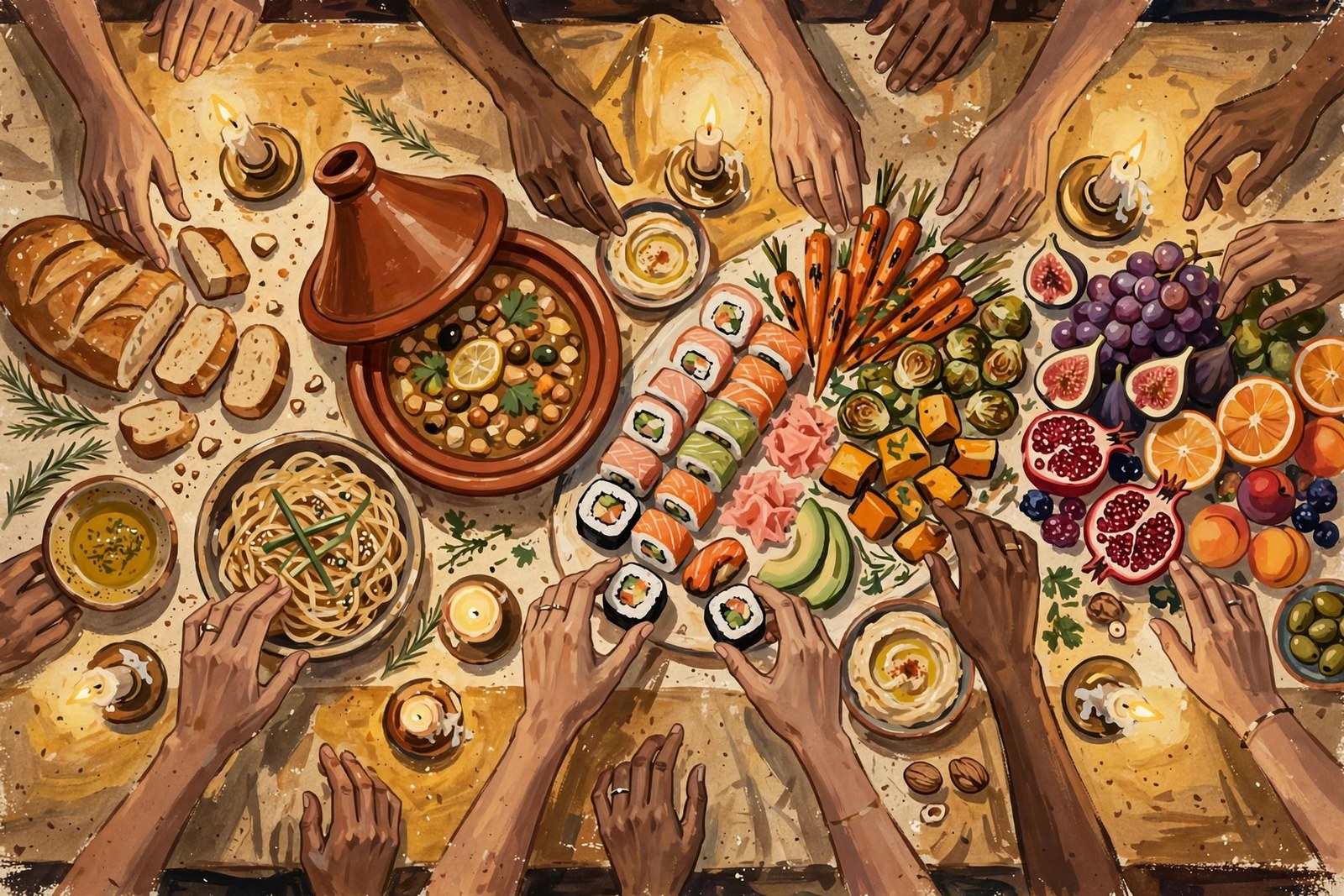
The meal as connection
Across cultures, sharing food is one of the deepest forms of connection. Being a gracious guest at the table earns goodwill everywhere.
Key differences
Utensils vary: chopsticks in East Asia (never stuck upright in rice!), hands in parts of India and the Middle East (right hand only), full cutlery in the West. Who pays, when to start eating, and how much to leave on your plate all vary.
Safe table habits
Wait to see if elders or hosts begin first. Try a bit of everything offered. Compliment the food. When unsure, observe and mirror your host. A sincere 'thank you' in the local language is always welcome.
Scenario: the empty plate dilemma
James is dining with his partner's family in Beijing. Determined to show appreciation, he finishes every dish completely — clean plates all around. His hosts look concerned and keep ordering more food. James eats until he's uncomfortable. What he didn't know: in many Chinese dining contexts, a fully cleared plate signals the host hasn't provided enough. Leaving a little food shows abundance and satisfaction.
What to do instead: watch the host's plate, not your own instincts. Eat well, compliment specifically (“this fish is incredible — how is it prepared?”), and leave a small amount when the meal is clearly abundant. In India, by contrast, finishing your plate is often the compliment — wasting food can offend. The rule isn't “always leave food” or “always finish”; it's read the table you're at.
Scenario: who pays?
Two friends — one from Seoul, one from New York — finish a great dinner. The New Yorker reaches for the bill to split it; the Korean friend looks genuinely hurt. In Korea, treating the whole table (especially as the inviter or the elder) is a point of honor; splitting can feel like a rejection of generosity. In the US, splitting is fairness.
What to do instead: let the inviter pay, gracefully, the first time — and say so warmly: “You invited me, this is yours — next one's mine.” Then actually follow through on “next one's mine.” This honors the treating culture while keeping the reciprocity your own culture values. Everyone's framework gets respected.
Three dining styles, compared
- Communal sharing — common as a tendency across East Asia, the Middle East, and parts of Africa: dishes in the center, everyone serves themselves or each other. Chopsticks, hands, or shared spoons; the meal is collective. Key skill: serving others before yourself, and never taking the last piece without offering it around.
- Formal coursed dining — a tendency in France, Italy, and formal Western settings: sequential courses, specific cutlery, paced by the host. Key skill: patience — wait for each course, keep pace with the table, and understand that lingering is the point.
- Casual individual plates — common as a tendency in the US, Australia, and casual Northern Europe: everyone orders their own, eating is efficient, splitting the bill is normal. Key skill: relaxing the efficiency when you're the guest in a slower food culture.
Whichever style you're in, the universal moves are the same: wait for the host's cue, try what you're offered, and compliment the cooking. For gift-giving at dinners (yes, it's related), see gift-giving etiquette.
Chopsticks, hands, and cutlery: a quick primer
- Chopsticks (China, Japan, Korea, Vietnam): never stick them upright in rice (it resembles funeral incense); don't spear food; rest them on the holder or the bowl's edge. In Japan, don't pass food chopstick-to-chopstick.
- Hands (India, parts of the Middle East and Africa): right hand only for eating; wash before and after; use the fingertips rather than the palm. It's a skill — nobody expects perfection, but the attempt is noticed and appreciated.
- Cutlery (West): continental and American styles differ, but nobody minds which you use. Resting positions signal “pausing” vs. “finished” — when in doubt, place utensils neatly together on the plate.
Practical exercise: the observation dinner
At your next shared meal — even in your own culture — spend the first ten minutes purely observing before acting: who serves first? Who starts eating first? What happens with the last piece? Write down three norms you noticed. This trains the exact muscle you'll need abroad: read before you act. Then explore the food traditions behind the manners in food traditions worldwide.
Common misunderstandings and fixes
Misunderstanding: “I'll just eat like I do at home; food is food.” Fix: food is never just food — it's hospitality, hierarchy, and history on a plate. Ten minutes of research before a dinner pays off for years in goodwill.
Misunderstanding: “Asking about the food is rude or too curious.” Fix: the opposite — specific compliments and curious questions about dishes are among the warmest things a guest can do. Cooks everywhere love talking about their food.
Misunderstanding: “Dietary restrictions will offend the host.” Fix: stated kindly and early, restrictions are almost always accommodated with grace. What's awkward is the surprise at the table. A quick note when accepting the invitation solves it — and our Japan country guide has specifics for one of the trickiest dining cultures to navigate.