
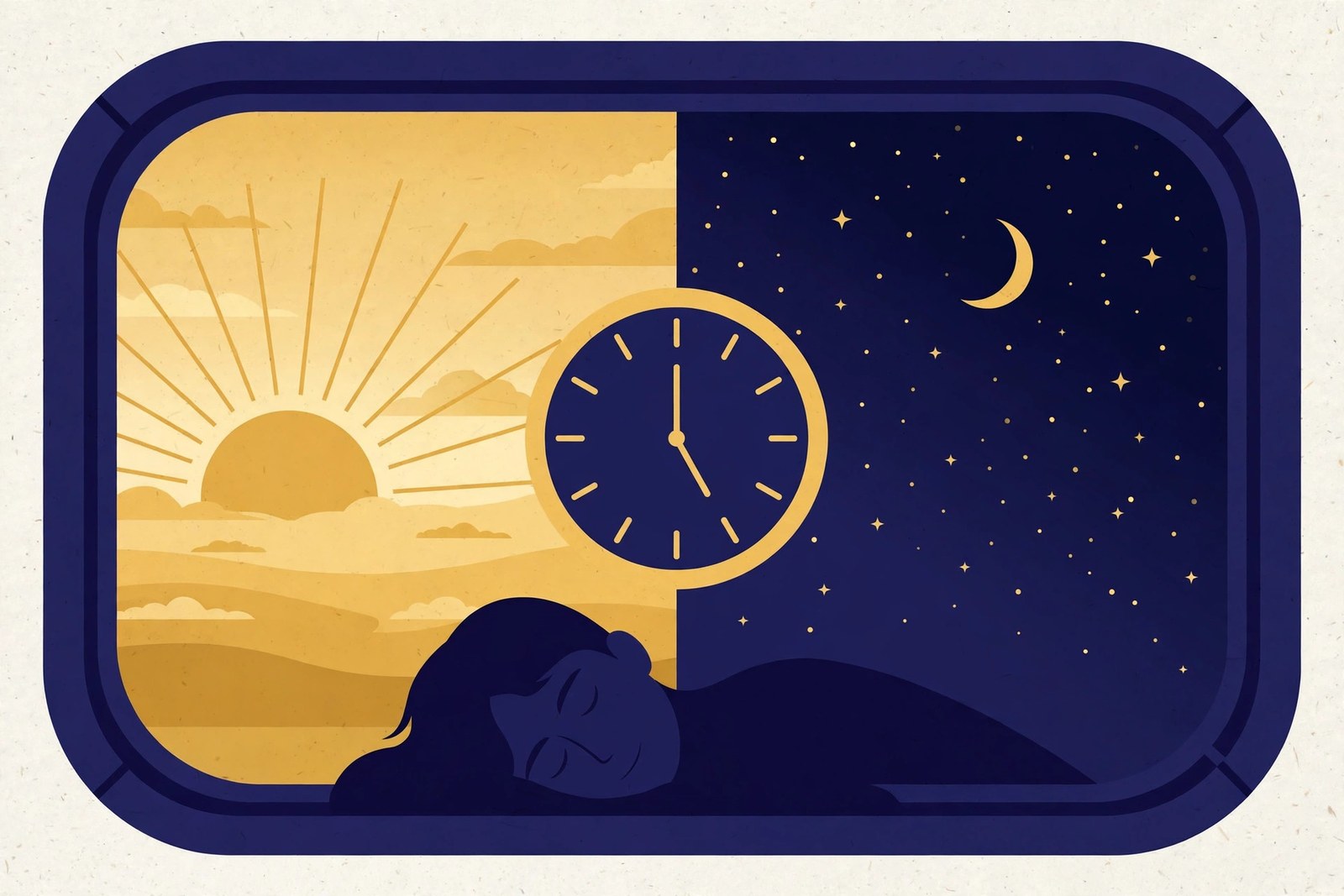
Why jet lag happens
Jet lag occurs when you cross time zones faster than your body's internal clock can adjust. Your circadian rhythm — which governs sleep, alertness, and digestion — stays on your home time, leaving you tired, foggy, and out of sync.
The more time zones you cross, the worse it tends to be, and traveling east is usually harder than west. Use our Time Zone Planner to understand the shift before you fly.
Strategies that actually work
- Shift your schedule a few days before departure toward your destination's time.
- Get sunlight at your destination — light is the most powerful clock-resetter.
- Stay hydrated and limit alcohol and caffeine on the flight.
- Adopt local time immediately — eat and sleep on the new schedule.
- Nap strategically — short naps only, to avoid disrupting night sleep.
- Be patient — your body adjusts roughly one time zone per day.
Arrive ready to explore
If you arrive during the day, resist the urge to sleep immediately. Get outside, stay active, and push through to a local bedtime. Morning sunlight at your destination helps your body recognize the new schedule fastest.
Plan lighter activities for your first day and save demanding plans for once you've adjusted. With these habits, you'll spend less time recovering and more time enjoying your trip.
The science in plain language
Your body runs on a roughly 24-hour cycle governed by a cluster of neurons in the brain called the suprachiasmatic nucleus — your master clock. This clock is set primarily by light hitting your eyes, and secondarily by meal timing, exercise, and social cues. When you fly across time zones, the external world shifts instantly but your master clock keeps ticking on home time. The mismatch is jet lag: your body wants sleep at noon and lunch at midnight.
Direction matters because your clock finds it easier to stay up later (delay) than to fall asleep earlier (advance). Westward travel — where you gain hours and stay up later — typically adjusts faster than eastward travel, where you must fall asleep earlier than your body expects. Age matters too: older travelers often find adjustment slower, and children sometimes bounce back faster. None of this is a character flaw — it is physiology, and it responds to the right inputs.
A day-by-day protocol
Three days before departure: begin shifting your sleep schedule by 30–60 minutes toward destination time — later if flying west, earlier if flying east. Shift meals along with sleep, since food is a secondary clock-setter. If you fly east, seek bright light in the morning and dim light in the evening; reverse this for westward travel.
On the flight: set your watch to destination time as soon as you board and live by it — eat, sleep, and stay awake according to the new clock. Hydrate steadily; cabin air is extremely dry, and dehydration worsens fatigue and headaches. Avoid alcohol, which fragments sleep, and time caffeine strategically: useful for staying awake during destination daytime, harmful within six hours of destination bedtime. Move around the cabin every couple of hours — it fights stiffness and helps circulation.
Day one at your destination: get outside into daylight as soon as possible. Morning light is the single strongest reset signal for eastward travel; late-afternoon light helps westward travelers. Eat meals on local time even if you are not hungry — your gut clock needs the memo. Take at most one short nap (20–30 minutes) before mid-afternoon, and protect your first local night: dark room, cool temperature, no screens for the last half hour.
Days two and three: keep anchoring with morning light and local meal times. Gentle exercise — a walk, a swim — helps more than intense workouts, which can overstimulate a tired body. Most travelers feel substantially better by day three; full adjustment takes roughly a day per time zone crossed, so be patient with an eight-hour shift.
What about melatonin and sleep aids?
Melatonin is a hormone your brain produces at night; small supplemental doses (typically 0.5–3 mg) taken at destination bedtime can help signal "night" to a confused clock, especially for eastward travel. It works best as a timing signal rather than a sedative — take it 30–60 minutes before the bedtime you want, for the first few nights. As with any supplement, check with your doctor first, particularly if you take other medications or have a health condition.
Prescription sleep aids are a heavier tool: they can force sleep but do not reset your clock, and they may leave you groggy. For most trips, light, meals, and schedule discipline do the real work. Save pharmaceutical help for situations where you must perform on day one — and discuss it with a clinician, not the internet.
Special cases
- Very short trips (1–2 days): if the time shift is large and the trip is brief, consider staying on home time instead — especially if you control your schedule. Shifting twice in 48 hours is worse than not shifting at all.
- Shift workers and new parents: if your sleep is already irregular, anchor ruthlessly to light exposure and meal timing — they are your most reliable clock-setters when sleep itself is chaotic.
- Children: shift their schedules a few days early like adults, keep the flight routine playful, and expect one rough day — kids often adjust quickly once the first local night lands.
Plan the time shift before you book with our Time Zone Planner, and give your first days the lightest itinerary — read our first-trip-abroad tips for building a forgiving arrival plan.
Jet lag myths worth dropping
Myth: you can "power through" without adjusting. Willpower cannot override circadian biology — an exhausted traveler makes worse decisions, enjoys less, and remembers little. Planning for adjustment is smarter than pretending you don't need it.
Myth: drinking alcohol on the flight helps you sleep. Alcohol may hasten sleep onset but it fragments sleep architecture and dehydrates you, leaving you more jet-lagged, not less. Save the celebratory drink for arrival.
Myth: the return trip is always easier. Eastward travelers often find the trip home harder, because they must advance their clock again. Budget a recovery day after you return, not just after you arrive.
Myth: one perfect trick fixes everything. No single hack — no app, supplement, or pair of glasses — replaces the fundamentals: light timing, meal timing, and sleep discipline. Use tools as supports, not substitutes.
Building a jet-lag-resistant itinerary
Work with your biology when planning. Schedule demanding activities — important meetings, challenging hikes, complex navigation — for days three onward on long-haul trips. Keep day one light: a neighborhood walk, a relaxed meal, an early night. If you must be sharp on day one, consider arriving a day earlier than you think you need; the extra hotel night is cheaper than a ruined first impression. For multi-stop trips, minimize back-and-forth time-zone jumps — a steady eastward or westward progression is far kinder than zigzagging.
When to seek medical advice
For most travelers, jet lag resolves within a few days and needs no medical attention. See a doctor if severe insomnia, digestive disruption, or mood changes persist beyond a week after return, or if you have a condition such as diabetes, epilepsy, or a sleep disorder that time-zone shifts could complicate. Medication schedules — especially insulin, blood thinners, or contraceptives — may need adjustment across zones; plan this with your clinician before you fly, not mid-trip. Frequent long-haul flyers should discuss cumulative sleep disruption with their doctor as part of routine care.