
Short answer: Tactile sensing gives a robot hand information at the contact patch itself: where the finger touches, how hard, in which direction the object is starting to slip, and something about its surface. A wrist force sensor reports one summed load for the whole tool; a camera sees the object only until the fingers close around it. Tactile sensors fill that blind spot, which is why nearly every serious attempt at human-like manipulation — including Sanctuary AI, whose public positioning for its general-purpose humanoids emphasises tactile sensing in the hands — treats touch as a requirement, not an accessory.
The last centimetre problem
Grasping fails in ways vision cannot diagnose. The object is two millimetres from where the model put it. It begins to rotate inside the grasp as it lifts. Its surface is more slippery than the planner assumed. A wrist sensor can report that total grip force changed, but not which finger lost contact or where the pressure concentrates — and for anything fragile, deformable or valuable, the difference between those reports is the difference between a recovered grasp and a dropped part. Tactile sensing exists to localise contact: force as a map, not a number.
Vision-based tactile sensors: a camera in the fingertip
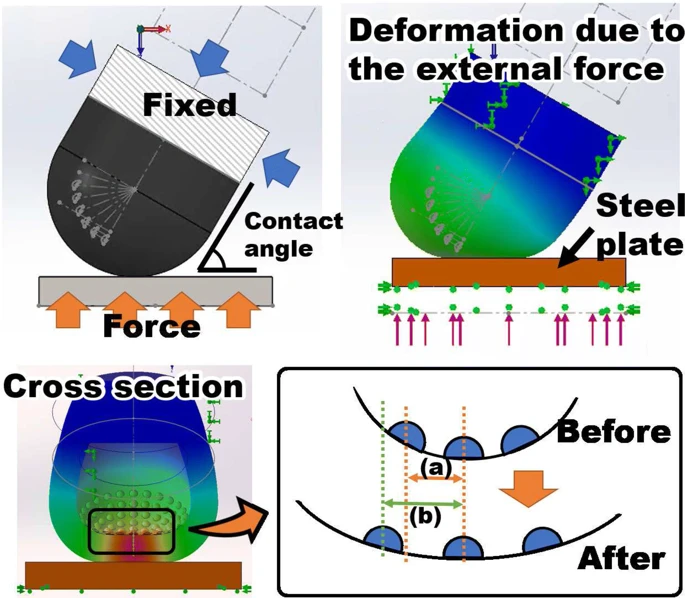
The most information-rich approach puts a small camera behind a soft elastomer pad. When an object presses into the pad, the surface deforms; the camera watches that deformation, often with internal lighting or printed markers, and software reconstructs contact geometry — shape, pressure distribution, shear. The output resembles an image of the contact itself, which makes it unusually legible to modern perception software. The costs are physical: the pad is a wear item, the sensor is bulkier than a fingertip wants to be, and the elastomer's properties change as it ages and tears.
Capacitive and piezoresistive arrays: skin as a grid
The other family spreads sensing elements — taxels — across the surface like a coarse skin. Capacitive arrays measure how each point's capacitance changes under pressure; piezoresistive materials change resistance as they compress. These arrays are thin, can wrap curved fingers and phalanges, and are generally simpler to wire into a hand than a camera per fingertip. Their limits are spatial resolution, hysteresis (the reading depends on whether force is rising or falling) and drift, which is why array-based skin tends to answer "where and roughly how hard" rather than producing the near-image that optical sensors return.
Slip detection and the grip-force loop
The highest-value tactile signal may be the simplest: incipient slip. As an object starts to slide, micro-vibrations and local shear changes appear at the contact before gross motion does. A controller watching for those signatures can add grip force in small increments — just enough to stabilise, no more — which is precisely the behaviour fragile goods, produce, glassware and polished parts require. This closed loop is where tactile sensing stops being instrumentation and becomes capability: it lets one gripper handle a range of weights and frictions that a fixed-force grasp cannot.
The hard problems nobody has fully solved
Durability leads the list: fingertips strike, drag and abrade, and every tactile technology puts something delicate exactly there. Calibration follows — elastomers age, resistive materials drift, and a hand with twenty sensors needs them to agree with each other over months, not minutes. Wiring and data plumbing through articulated fingers is its own engineering discipline. And cost multiplies by the finger: a sensor price that is reasonable on a research hand becomes a product decision on a hand with five fingers and three joints each. These are the reasons tactile sensing is standard in research and premium hands — the territory of our dexterous hands survey — and still selective in production grippers.
Tactile versus wrist force sensing: a division of labour
The two senses are complements, not competitors. The wrist sensor measures the whole tool's load — weight, inertia, contact with the environment, collisions along the arm — and drives arm-level compliance. Tactile sensors measure the contact patch and drive finger-level decisions. A well-instrumented hand uses both, exactly as a human arm combines proprioception with fingertip skin. For the wrist side of the pairing, see our guide to force and torque sensors. Suppliers working on hands and their sensing are listed in the end effectors and dexterous hands section of the directory.
Frequently asked questions
What is tactile sensing in robotics?
It is sensing at the contact surface of a gripper or hand: sensors in the fingertips or palm report where contact happens, how pressure distributes, and whether the object is starting to slip. It complements cameras, which cannot see the contact once fingers close, and wrist sensors, which report only the summed load.
What are the main tactile sensor technologies?
Two families dominate. Vision-based sensors put a camera behind a deformable pad and reconstruct the contact from its deformation. Electronic skins use grids of capacitive or piezoresistive elements spread over the surface. Optical designs return richer data; arrays are thinner and easier to integrate.
Why does slip detection matter so much?
Because it enables minimum-force grasping. Detecting incipient slip lets the controller add grip force only as needed, which is how a hand can hold fragile, slippery or variable objects without crushing them or pre-setting a conservatively huge grip force.
Do production robot grippers have tactile sensing today?
Selectively. Tactile sensing is common in research hands and premium dexterous systems, and simpler forms such as grip-force feedback and slip detection appear in production devices. Full high-resolution tactile skin remains limited by durability, calibration and cost per fingertip.