
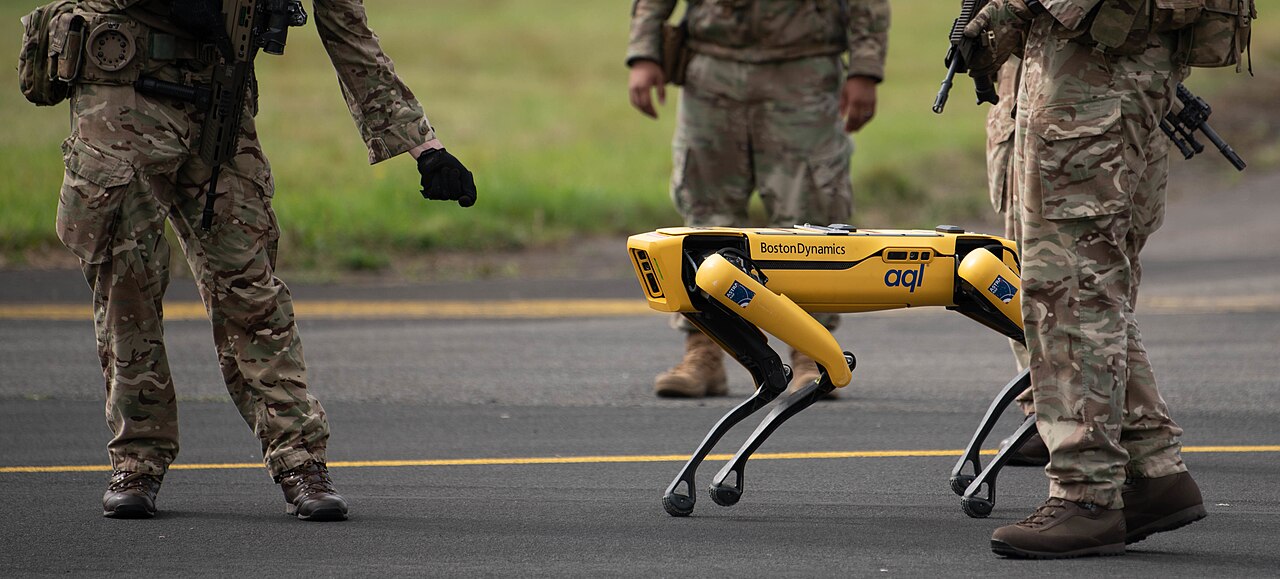
Short answer: quadruped robots are bought for routine inspection in places built for human legs: stairs, gravel yards, raised grating, cable trays and thresholds. A wheeled robot is cheaper and more efficient on flat floors; a four-legged robot keeps going where the floor ends. Equipped with cameras, thermal imagers, microphones and gas sensors, quadrupeds such as Boston Dynamics' Spot and ANYbotics' ANYmal run repeatable inspection rounds, read gauges, spot hot spots and record the same route the same way every shift — the consistency, as much as the mobility, is the product.
The payload decides the value
The legs get the attention, but the business case sits on the robot's back. A typical inspection payload combines a zoom camera for reading analogue gauges and labels, a thermal camera for overheating breakers and motors, an acoustic sensor for bearing and leak sounds, and increasingly a gas or radiation sensor for hazardous zones. Each round produces comparable data — the same gauge photographed from the same angle every day — which turns inspection from a human walk with a clipboard into a trend line. When a value drifts, maintenance hears about it before the failure. Buyers should therefore spec the payload and the data output first, and treat locomotion as the delivery mechanism.
The autonomy loop around the robot
A working deployment is a loop, not a robot: mapped routes with defined inspection points, a docking station where the robot charges between rounds, software that schedules missions and flags anomalies, and an integration path into the plant's maintenance system. ANYbotics built its ANYmal specifically around this loop for energy and industrial sites, and Boston Dynamics — founded in 1992 by Marc Raibert, who later founded the Robotics & AI Institute — has sold Spot commercially since 2020 with the same inspection-round positioning. Chinese makers such as Unitree sell quadrupeds at far lower price points, widely used as development and research platforms; the gap to the industrial leaders is less in the walking than in payloads, environmental ratings and fleet software.
Where legs beat wheels — and where they do not
- Legs win: multi-level plants, offshore and energy sites, substations and mines, anywhere the route includes stairs, gaps, loose ground or door thresholds.
- Wheels win: flat warehouses and factories, long straight routes, heavy payloads, and anywhere a rail or a fixed sensor could do the job at a tenth of the cost.
- Neither wins: one-off inspections. If the route will not be walked weekly for years, a person with a camera remains the flexible option.
Checks before a pilot
- Environmental rating and fall behaviour: ask for the ingress-protection rating, the operating temperature range, and what the robot does after a slip — recovery behaviour matters more than top speed.
- Endurance honesty: runtime with the full payload fitted, not the bare robot; and the charge time at the dock.
- Data ownership: where inspection data lives, in what format it exports, and whether the analytics subscription is the real price.
- Route proof: have the vendor run your worst staircase and your longest threshold on site before signing.
The economics, stated plainly
The comparison that justifies a quadruped is rarely robot versus robot. It is robot versus the alternatives for the same route: fixed sensors at every inspection point (accurate, but each point is its own installation), a human inspector's time across years of shifts, or the cost of the failure nobody saw coming — the overheating breaker or the leaking flange on an unwalked route. A quadruped carries its sensors to every point on legs it already owns, which is why the strongest cases are large sites with many dispersed inspection points and a shortage of people willing to walk them at 3 a.m. Sites with few points, or points a camera pole can see, should buy the pole.
Quadrupeds sit inside the directory's complete robots and platforms category (233 companies as of 10 November 2026). For inspection buyers, the category map is the fastest way to see which makers sell a finished inspection system and which sell a platform you must build on.
Frequently asked questions
What are quadruped robots used for in industry?
Routine inspection of facilities whose terrain defeats wheels: energy plants, substations, chemical sites, mines and multi-level industrial buildings. Fitted with visual, thermal, acoustic and gas sensors, they walk fixed routes, read gauges, detect hot spots, leaks and abnormal sounds, and return comparable data every round so changes are spotted early.
How does a quadruped compare with a wheeled inspection robot?
On flat floors the wheeled robot wins on cost, endurance and simplicity. The quadruped wins wherever the route includes stairs, gravel, grating, gaps or thresholds — terrain designed for legs. The decision is therefore about the worst ten metres of the route: if wheels can cover all of it, buy wheels; if not, the quadruped is the only mobile option short of fixed sensors.
Which companies make inspection quadrupeds?
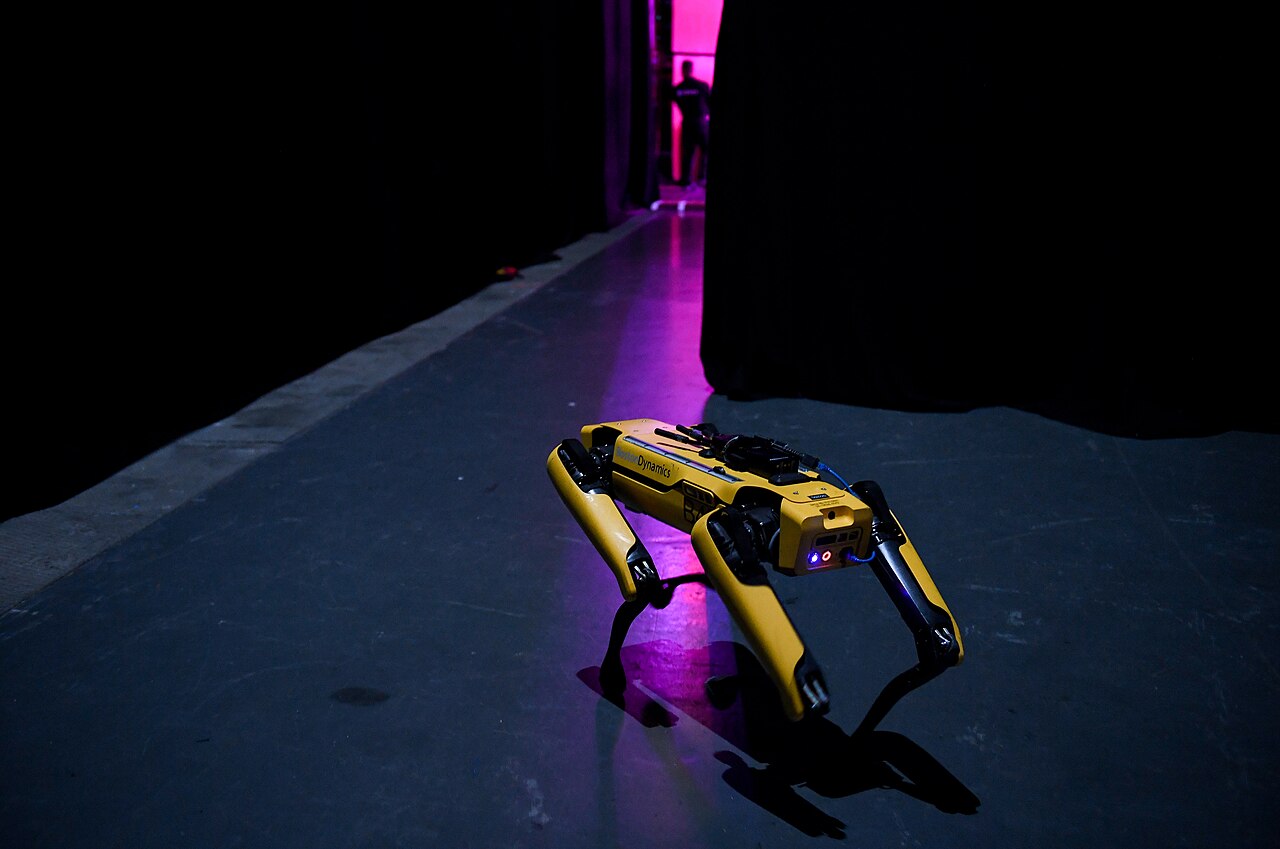
Boston Dynamics' Spot, sold commercially since 2020, and ANYbotics' ANYmal, designed specifically for industrial and energy inspection, are the reference systems. Unitree's quadrupeds are popular lower-cost development platforms. The industrial difference lies less in walking ability than in payloads, environmental ratings, docking and fleet software — the parts that turn a robot into an inspection service.
What should a buyer verify before a quadruped pilot?
Four things: the environmental protection rating and what the robot does after a fall or slip; real endurance with the full inspection payload fitted, plus dock charging time; how inspection data is stored and exported, and what the analytics subscription costs; and a live demonstration on your own worst terrain — your stairs and thresholds, not the vendor's showroom floor.