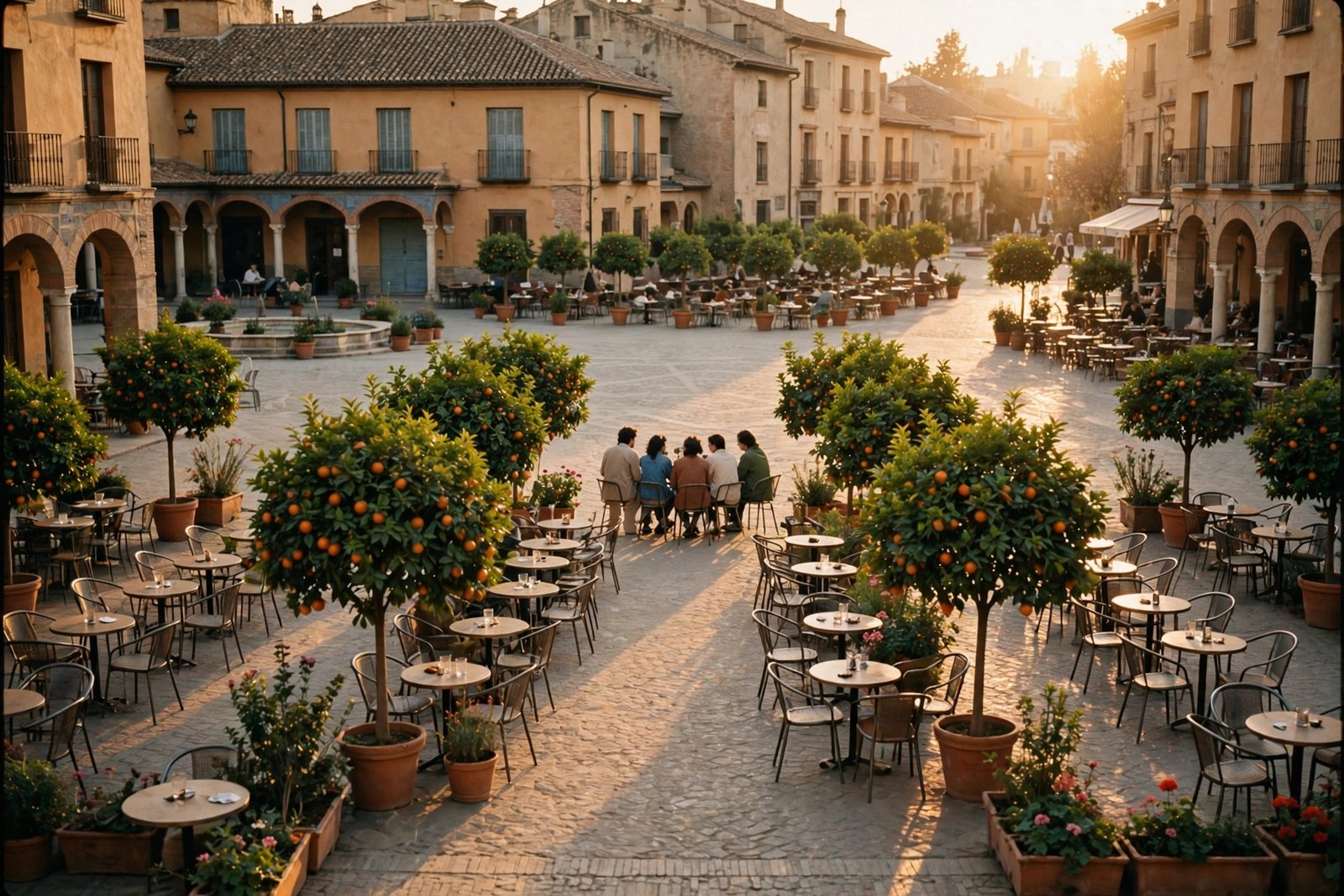
Cultural Notes & Etiquette
- Daily rhythm is late — dinner often after 9 PM, with siesta breaks in some areas.
- Two cheek kisses (right cheek first) are common greetings among friends.
- Social life revolves around family, friends, and long shared meals or tapas.
- Spaniards are warm, expressive, and value face-to-face connection.
- Regional identities (Catalonia, Basque Country, etc.) are strong and distinct.
Remember: these are general cultural observations to build awareness, not rigid rules. Every person in Spain is an individual shaped by region, generation, and personal experience. Lead with curiosity and respect.
Greetings & First Impressions
Expect two cheek kisses (right cheek first) even when meeting someone for the first time socially — it is warm, not overly familiar. Hola works everywhere, and in business settings a handshake is standard. Spaniards are tactile and expressive; standing a bit closer than you might be used to is normal. First names are used quickly, even in many workplaces. For more on how greetings differ globally, see greetings around the world.
Dining Customs
Meal times run late: lunch (la comida) is the main meal, typically between 2 and 4 pm, and dinner rarely starts before 9 pm — restaurants fill up around 10. Tapas are shared plates at the center of the table; order a variety and share. The sobremesa — lingering at the table chatting long after the plates are cleared — is sacred; don't rush it. Bread accompanies the meal, and wine is the default drink. In the Basque Country, try the txoko tradition of social dining clubs if you get the chance.
Tipping Norms
Tipping is not obligatory in Spain, but rounding up the bill or leaving 5–10% for good service in restaurants is appreciated. In casual tapas bars, leaving small change on the bar is a nice gesture. Service staff earn proper wages, so tips are a bonus rather than an expectation — tip for genuine warmth of service, not out of obligation.
Gift-Giving Notes
When invited to a Spanish home, bring wine, dessert, or flowers (in odd numbers; avoid dahlias and chrysanthemums, which carry funeral associations). Gifts are usually opened when received. If your host has a garden, don't bring flowers — it can imply their garden is inadequate. Small gifts for children are always welcome. Our gift-giving etiquette guide has more worldwide traditions.
Business vs Social Norms
Personal connection comes first in Spanish business culture — expect conversation about family, food, and life before any talk of deals. Meetings often run long, and lunch meetings are common and productive. Punctuality is expected for business but flexible socially (arriving 15–30 minutes "late" to a party is normal). Note Spain's regional diversity: Catalonia, the Basque Country, and Galicia have distinct languages and strong identities — showing interest and respect for regional culture is appreciated.
Useful Spanish Phrases
- Hola, ¿qué tal? — "Hi, how's it going?"
- Gracias / Muchas gracias — "Thank you / Thank you very much"
- Por favor — "Please"
- Perdón / Disculpe — "Sorry / Excuse me"
- La cuenta, por favor — "The check, please"
- ¿Habla inglés? — "Do you speak English?"
Practice with our Language Helper or browse useful phrases for travelers.
Planning Around Spain's Calendar and Clock
When the country is busy or closed. August is a slow month for business, with many small companies closing for weeks. National holidays include Epiphany on January 6, when gifts are traditionally exchanged, Good Friday, May 1, the Assumption on August 15, National Day on October 12, All Saints on November 1, Constitution Day on December 6, the Immaculate Conception on December 8, and Christmas. Each region and city adds its own, and local festivals such as Holy Week processions, San Fermín in Pamplona in July and Las Fallas in Valencia in March shut their cities down for days.
Working hours. Spain runs late. Lunch is the main meal and is eaten between about 2:00 and 4:00 pm; shops outside the big cities and chains often close for part of that window and reopen until 8:00 or 9:00 pm. Dinner rarely starts before 9:00 pm, and a 7:00 pm reservation marks you as a visitor. Office hours in larger companies are moving towards a continuous day, but a late lunch is still the norm.
Time difference, with an example. Mainland Spain and the Balearic Islands use Central European Time, UTC+1 in winter and UTC+2 in summer; the Canary Islands are one hour behind. Madrid is 9 hours ahead of California and 6 hours ahead of New York for most of the year. A worked example: because Spaniards eat late, 10:30 pm in Seville is a normal time to be awake and relaxed, and that is 1:30 pm in California and 4:30 pm in New York, a comfortable window for a long call. The Time Zone Planner covers the Canaries and the clock-change weeks.
Money and tipping. Tipping is light: rounding up or leaving small change in cafés, and a few euros or around five percent in restaurants for good service. Cards are accepted almost everywhere, including for small amounts.
Practical Do's and Don'ts
- Do embrace the late schedule — plan dinners for 9:30 pm or later.
- Do try regional specialties wherever you travel within Spain.
- Don't expect shops and restaurants to follow northern-European hours; the midday break is real in smaller towns.
- Don't confuse Spain's regions — a little homework on local identity goes a long way.
Working with partners in Spain: a 40-hour framework and a later daily rhythm
Spain's legal frame is set by the Workers' Statute (Estatuto de los Trabajadores), which caps the ordinary working week at 40 hours of effective work, calculated as an annual average (Article 34, published in the Boletin Oficial del Estado). Within that frame, the lived rhythm is what catches foreign partners out: the business day in much of Spain starts and ends later than in northern Europe, lunch is a substantial midday break rather than a sandwich at a desk, and dinner — including business dinner — is a late-evening event by British or German standards. Scheduling a "quick call" at what is lunchtime in Madrid, or proposing a working breakfast at an hour your counterpart considers early, creates friction that has nothing to do with willingness.
August deserves the same respect here as in Italy and France: it is the traditional holiday month, many firms run reduced operations, and some close entirely for part of it. Confirm in writing which weeks your partner will be away, and do the same around the Christmas period and local festivals, which vary by autonomous community and city — a public holiday in one region is a normal workday in another. Ask for your partner's local calendar rather than working from a national list.
Two communication notes complete the picture. First, Spain is multilingual: Castilian Spanish is universal in business, but in Catalonia, the Basque Country, Galicia, and Valencia, regional languages are co-official and visible in signage, documents, and daily life; acknowledging the local language politely costs nothing and is noticed. Second, relationships carry weight: a partner who has eaten with you and knows your company beyond the spreadsheet will move mountains that a contract alone will not. For dependable data, use the Instituto Nacional de Estadistica (INE) or the World Bank country page, and see how Spain compares with neighbours in our Country Comparison Tool.
Sources and further reading