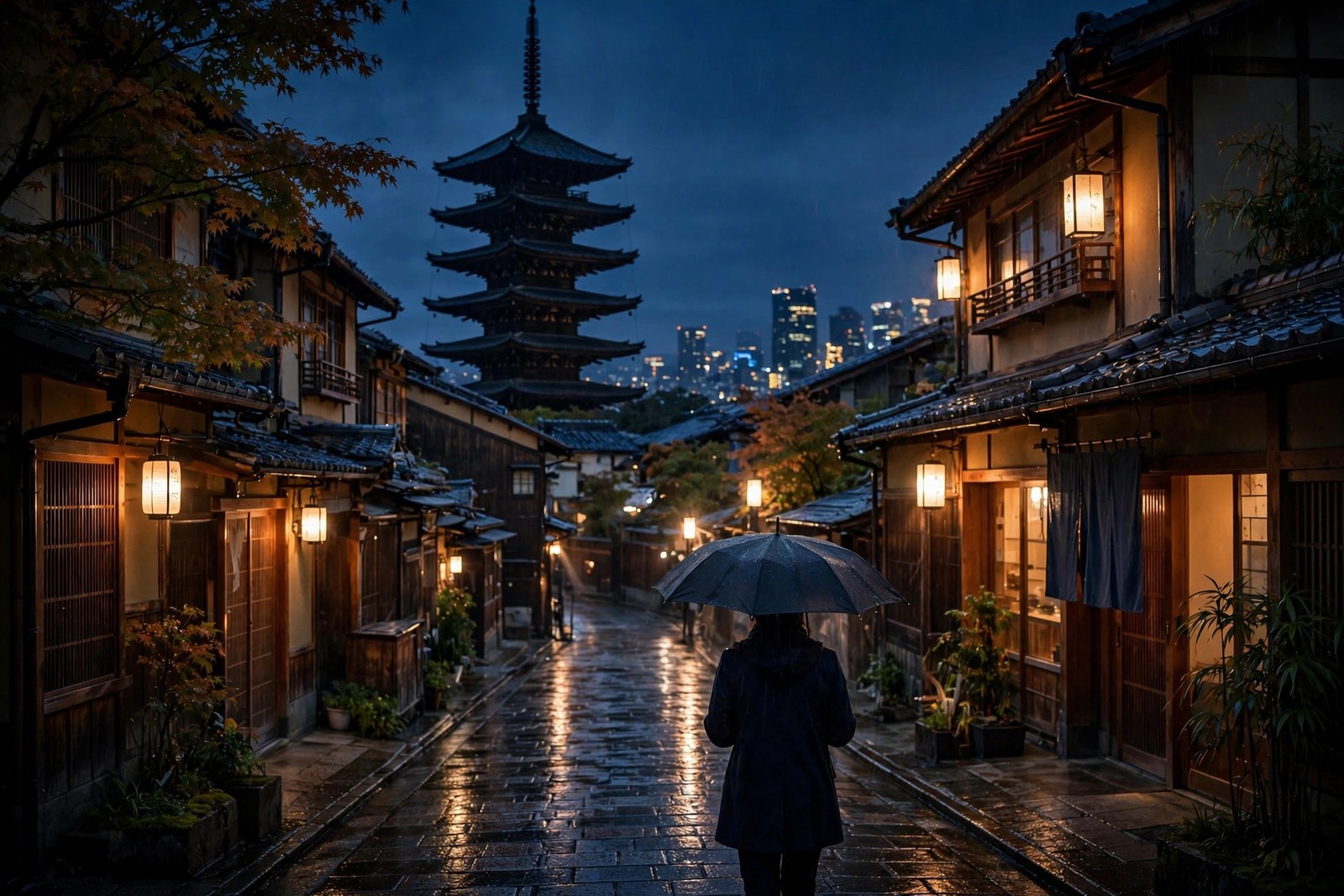
Cultural Notes & Etiquette
- Politeness, harmony, and respect are core social values. Indirect communication is common — people often avoid direct refusals to preserve harmony.
- Bowing is the traditional greeting; its depth signals respect. Removing shoes indoors is essential.
- Gift-giving (omiyage) is an important social ritual, with great attention to presentation.
- Tipping is not customary and can even cause confusion. Punctuality is highly valued.
- Quietness in public spaces, especially on trains, is the norm.
Remember: these are general cultural observations to build awareness, not rigid rules. Every person in Japan is an individual shaped by region, generation, and personal experience. Lead with curiosity and respect.
Greetings & First Impressions
The bow (ojigi) is Japan's traditional greeting, and its depth and duration signal the level of respect — a small nod works fine for everyday encounters, while deeper bows mark formal apologies or gratitude. As a visitor, you are not expected to bow perfectly; a respectful nod in return is warmly received. In international business settings, handshakes are common, sometimes combined with a slight bow.
Shoes come off at the genkan (entryway) of homes, many traditional restaurants, temples, and some inns — wear clean, presentable socks, since you will often be in full view of your host. When exchanging business cards (meishi), offer and receive with both hands, take a moment to read the card, and place it carefully on the table or in a cardholder rather than pocketing it immediately. If you want to go deeper on greetings across cultures, see our guide to greetings around the world.
Dining Customs
Say itadakimasu ("I humbly receive") before eating and gochisousama deshita ("thank you for the meal") afterward — these small phrases are noticed and appreciated. Never stick chopsticks upright into a bowl of rice (tatebashi), which resembles a funeral ritual, and avoid passing food directly from chopsticks to chopsticks for the same reason. Slurping noodles is perfectly acceptable and even signals enjoyment. When drinking with others, pour for your companions and hold your own glass with both hands when someone pours for you.
Tipping Norms
Tipping is not customary in Japan and can genuinely confuse staff — exceptional service is simply the standard. Leaving coins on a table may prompt someone to chase after you thinking you forgot your change. Some high-end restaurants add a service charge to the bill, which is stated upfront. A sincere verbal thank-you carries far more weight than a tip.
Gift-Giving Notes
Gift-giving (omiyage) is a meaningful social ritual: travelers bring small regional souvenirs for colleagues, friends, and hosts. Presentation matters enormously — beautiful wrapping is part of the gift itself. Offer and receive gifts with both hands. It is polite to modestly downplay the gift ("it's nothing much"), and the recipient may set it aside to open later rather than in front of you. Our broader gift-giving etiquette guide covers more traditions worldwide.
Business vs Social Norms
In business, punctuality is non-negotiable — arriving a few minutes early is the norm, and hierarchy shapes seating, speaking order, and decision-making. Communication tends to be indirect; a vague "that might be difficult" often means no. Socially, people are warm but reserved with strangers at first. After-work gatherings (nomikai) are where real bonding happens, and attending them shows respect for the group. Public behavior stays quiet and considerate — keep your voice down on trains and avoid phone calls in carriages.
Useful Japanese Phrases
- Konnichiwa (こんにちは) — "Hello" (daytime greeting)
- Arigatou gozaimasu (ありがとうございます) — "Thank you very much"
- Sumimasen (すみません) — "Excuse me" / "I'm sorry" (remarkably versatile)
- Onegaishimasu (お願いします) — "Please" (when requesting something)
- Eigo o hanasemasu ka? (英語を話せますか?) — "Do you speak English?"
Practice these with our Language Helper, and see useful phrases for travelers for more languages.
Planning Around Japan's Calendar and Clock
When the country is busy or closed. Three periods matter more than any single holiday. Golden Week (late April into the first week of May) strings several national holidays together; trains and hotels fill, prices rise and many offices close for the stretch. Obon in mid-August is not an official public holiday but is the time families return to their hometowns, so expect packed transport and quiet offices. New Year is the real shutdown: from about December 29 to January 3 most businesses, banks and many restaurants close, and the first days of January are spent on family visits and shrine trips. If you are arranging a call, a delivery or a visit with someone in Japan, avoid these three windows or expect a slow answer.
Working hours. Offices generally run 9:00 to 18:00 on weekdays, with lunch commonly around noon. Banks keep shorter hours, typically closing mid-afternoon on weekdays and shut at weekends. Shops in cities open around 10:00 and stay open into the evening, including Sundays; convenience stores are open around the clock.
Time difference, with an example. Japan is on UTC+9 all year and does not observe daylight saving. From the US West Coast that means Tokyo is 16 hours ahead in summer and 17 in winter; from New York, 13 hours ahead in summer and 14 in winter. A worked example: if you are in California and want to catch a friend in Osaka at 8:00 pm their time on a weekday in July, you call at 4:00 am your time; the more comfortable window is your early evening, which is their morning the following day. Our Time Zone Planner does this arithmetic for any pair of cities.
Money and tipping. Tipping is not customary and can cause confusion; good service is simply expected. Cards and transit IC cards are accepted widely in cities, but smaller restaurants, rural shops and some temples still prefer cash, so carry some yen.
Practical Do's and Don'ts
- Do carry cash — many small shops, ramen counters, and temples are cash-only.
- Do stand on the correct side of escalators (left in Tokyo, right in Osaka) and queue neatly for trains.
- Don't talk loudly on public transport or take phone calls in train carriages.
- Don't blow your nose in public; step aside or wait until you are in private.
Working with partners in Japan: the 40-hour law and the consensus behind the answer
Japan's legal baseline is precise: the Labor Standards Act (Article 32) caps regular working time at 40 hours per week and 8 hours per day, excluding breaks. What foreign partners experience, however, is the layer built on top of that baseline — overtime practices, presenteeism in some sectors, and above all a decision process that prizes consensus. Both layers are real. Quoting the statute at a Japanese counterpart will not speed anything up, but understanding it helps you read the situation: a team that stays late is signalling commitment within its own norms, not inviting you to schedule still more meetings.
The consensus process (often called nemawashi, the informal groundwork done before a formal proposal) is the part visitors most often misread. A meeting in Japan frequently ratifies a direction that has already been sounded out individually; silence in the meeting is therefore not necessarily disagreement, and an on-the-spot demand for a final decision can put your counterpart in an impossible position, because they may not be authorised to commit the group alone. The productive approach is to share materials early, ask who else should see them, and treat "we will consider it" as a genuine stage in the process rather than a polite no.
Practical additions: address people by family name plus -san until invited otherwise, exchange business cards (or their digital equivalent) with attention rather than as an afterthought, and summarise agreed points in writing after each meeting — in Japanese business culture the written follow-up is a courtesy that prevents the misunderstandings silence can hide. If your project spans time zones, plan the overlap deliberately with our guide to the best time to call Japan. For authoritative data on Japan's economy and population, use the Statistics Bureau of Japan or the World Bank country page, not figures repeated in travel blogs.
Sources and further reading
From skincare to stationery, Japanese brands have found devoted audiences in North America — often by understanding local culture first. If you represent a Japanese brand exploring the U.S. market, learn how the GlobleMatch Global Launchpad works.