
Short answer: Welding is the classic first robot application in metal fabrication because the labour is scarce, the work is repetitive within part families, and the quality argument is immediate: a robot lays the same bead on the four-hundredth part as on the first. The modern entry point is a cobot or compact welding cell rather than a full automotive line — but the project's real centre of gravity is not the robot. It is the fixtures that present every part in exactly the same place, every time.
Why welding leads
Fabrication shops feel the welder shortage more directly than almost any other trade, and welding concentrates several automation-friendly properties in one process: the skill is scarce and ageing, the quality is measurable, the parts repeat in families, and the work itself — heat, fume, arc flash — is work people are glad to hand over. The robot does not need to weld everything in the shop to pay: it needs the recurring families, leaving the one-offs and repairs to the human welders whose skill those jobs actually require. Makers such as Yaskawa, whose Motoman welding robots are a long-standing reference in the category, now field both traditional cells and compact systems aimed squarely at this mid-size entry point; the category sits in the directory's platforms section.
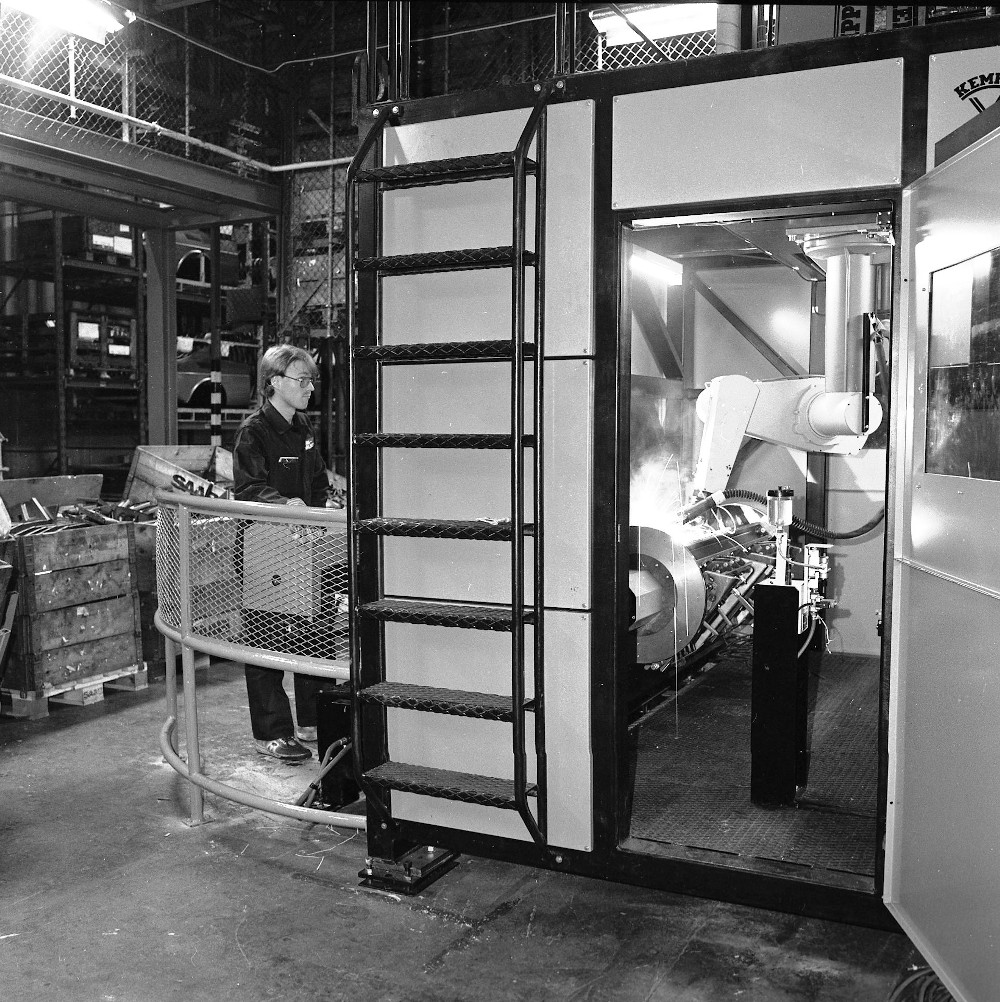
Cobot welding vs the dedicated cell
The cobot welding cell — a collaborative arm carrying a MIG torch, often on a table or cart — trades the fenced cell's speed and duty for flexibility, a small footprint and fast redeployment between jobs. The dedicated cell wins on throughput, heavier parts and positioners that present work at ideal angles. The decision rule is the mix: high repetition of heavier assemblies argues for the cell; varied small batches on a shop that cannot spare the floor space argue for the cobot. Either way, the torch, wire feeder and power source are a process package of their own — the subject of our guide to process end effectors.
Fixtures: the hidden main act
A human welder compensates for a badly fitting part without noticing. A robot welds exactly where it was programmed, so part variation and loose fixturing become weld defects with industrial consistency. Successful shops therefore budget fixtures as a first-class project cost: clamping that locates parts repeatably, tack-up discipline upstream, and positioners for the heavy pieces. When a welding robot project disappoints, the post-mortem rarely blames the robot; it finds parts arriving with gaps the programme never anticipated. Treat the fixture line in any quotation as the tell of the integrator's experience.
The programming barrier is falling
Historically, robot welding demanded a programmer. Modern entry systems attack exactly that barrier: hand-guiding the torch through the seam, touch-screen sequence building, and offline programming from part drawings all reduce the specialist burden. The honest caveat is that easier programming does not remove welding knowledge — parameters, joint preparation and defect diagnosis remain welder's craft, now applied through a different interface. Shops that keep a senior welder as the cell's owner-operator succeed; shops that treat the cell as unstaffed equipment stall at the first porosity problem.
Safety and extraction are part of the cell
A welding cell is also a safety installation. The arc's flash demands screening or enclosed guarding with interlocked access; welding fume requires extraction sized to the duty cycle, positioned where the plume actually rises; and the fire watch and hot-work rules of the shop apply to the robot's work as much as to a human's. Cobot cells reduce some guarding through power and force limiting, but the arc itself does not become collaborative — eye protection and fume control remain. Budget these items inside the cell project: extraction retrofitted after an occupational-health visit costs more than extraction designed in, and a cell stopped for a missing interlock welds nothing at all.
Parts that suit — and parts that don't
Suit: recurring frames, brackets, tanks, enclosures and assemblies in stable families, with fit-up the shop can control. Resist: one-off structural work with site-measured variation, parts whose tolerances the upstream process cannot hold, and volumes so low that fixture cost per part never amortises. Existing shops adding a first cell into a working factory should also read the brownfield lessons in our guide to retrofitting automation into running factories — power, extraction and floor space have ended more first-cell projects than robot selection ever has.
Frequently asked questions
Why is welding usually a fabrication shop's first robot?
Welders are scarce, the work repeats in part families, quality is measurable, and the robot lays the same bead on the four-hundredth part as on the first. The recurring families alone can justify the cell while humans keep the one-offs.
Should a small shop choose a cobot welder or a dedicated cell?
High repetition of heavier assemblies argues for the dedicated cell with positioners. Varied small batches and tight floor space argue for the cobot cell, which redeploys quickly but welds slower and lighter.
Why do fixtures matter so much in robot welding?
A robot welds exactly where it was programmed, so part variation that a human welder absorbs becomes consistent defects. Repeatable clamping, disciplined tack-up and positioners are first-class project costs, not accessories.
Does easier programming remove the need for welding skill?
No. Hand-guiding and offline tools lower the programming barrier, but weld parameters, joint preparation and defect diagnosis remain welder's craft. Successful shops keep a senior welder as the cell's owner-operator.