
Short answer: Choose by the geometry of the task. SCARA robots are the planar specialists: fast, stiff horizontal assembly and handling at bench scale. Delta robots are the speed extreme: very light parts picked and placed at rates nothing else matches, over a limited dome-shaped workspace. Articulated six-axis arms are the generalists: they reach around, tilt and reorient, at lower top speed and higher cost per kilogram of payload. Most wrong purchases come from buying the generalist for a planar job, or the specialist for a task that quietly needed a wrist.
SCARA: the planar assembly machine
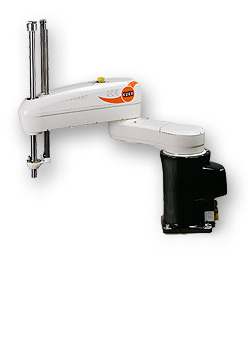
A SCARA arm rotates two horizontal links and moves a vertical quill up and down — rigid in the vertical direction, compliant sideways, which is exactly what inserting parts into boards and fixtures wants. Cycle times for small assembly moves are excellent, the footprint is a post or a bench mount, and the programming is simple because the motion stays in one plane. The limits are the same plane: reach is an annulus around the base, payloads are small (benchtop to light industrial), and any task that needs the part tilted or presented at an angle is outside the design. Electronics assembly, screwdriving, dispensing and small-part handling are its home ground — the segment our guide to robots in electronics and 3C assembly examines from the industry side.
Delta: speed above everything
The delta configuration hangs a light moving platform from three parallelogram arms driven at the base. Because the motors do not ride on the moving structure, the moving mass is tiny and accelerations are extreme: delta robots pick small items — chocolates, pills, packaged goods, small components — from moving conveyors at rates that define their category. ABB's IRB 360 FlexPicker is the reference product that normalised the type in packaging halls. The trade-offs are structural: payloads are a few kilograms at most, the workspace is a shallow dome under the mount, and the tool points mostly downward. Where the product stream is light, fast and flat, nothing else is competitive; outside that envelope, nothing else is as limited.
Articulated: the six-axis generalist
The articulated arm stacks rotary joints like a human arm and shoulder: it reaches over, under and around, reorients parts freely, and works in three dimensions over the largest workspace of the three. It is the only one of the three that welds, paints, machines-tends and handles parts of arbitrary presentation — and the default when the task list is mixed or still changing. The costs of generality are a bigger footprint for the same reach, lower cycle rates on simple planar moves, and programming that has to manage a genuinely three-dimensional machine. When the task is not yet fully specified — the common case in job shops — that flexibility is worth its price; when the task is fixed and planar, it is money spent on motion never used. Buyers comparing specific models should then move to the nameplate numbers, which our guide to reading a robot datasheet explains how to interpret.
The comparison that matters
Four questions sort most applications. Does the part need reorientation? If yes, articulated is the only candidate. What are the payload and the rate? Very light parts at extreme rates point to delta; light parts at high rates in a plane point to SCARA; heavier parts or complex paths point to articulated. What shape is the workspace? A bench, a conveyor line, and a machine tool's interior are three different geometries. What changes next year? Fixed products reward specialists; changing products reward the generalist's forgiveness. Price follows the same logic: per unit of pure planar cycle rate, SCARA and delta are far cheaper than articulated arms; per unit of flexibility, the comparison inverts. The directory's complete robots section lets buyers filter the supply side by exactly these families, and ABB Robotics — which fields all three architectures — is a useful first profile for seeing how one maker's range maps onto them.
Typical verdicts
Electronics assembly and test handling: SCARA, with articulated arms at line ends for awkward orientations. Food and consumer-goods primary packaging: delta over the conveyor, SCARA or articulated for case handling. Machine tending, welding, deburring and mixed manufacturing: articulated, essentially unopposed. The instructive failures are the boundary cases — a delta bought for parts slightly too heavy, a six-axis arm doing a SCARA's job at twice the price and half the rate. Kinematics is the cheapest decision to get right and the most expensive to retrofit.
Frequently asked questions
What is the main difference between SCARA and articulated robots?
Motion geometry. A SCARA moves in a horizontal plane with a vertical stroke — fast and stiff for bench assembly, but unable to tilt or reorient parts. An articulated six-axis arm moves freely in three dimensions and reorients parts arbitrarily, at lower top speed and higher cost for the same reach.
When is a delta robot the right choice?
When parts are very light, the work is pick-and-place over a conveyor or tray, and rate is the priority. Delta robots achieve the highest pick rates of any architecture, but payloads are only a few kilograms and the workspace is a shallow dome beneath the mount.
Which robot type is cheapest?
For a fixed, planar task, a SCARA typically delivers the cycle rate at the lowest cost; a delta is cheapest per pick at extreme rates. An articulated arm costs more for the same simple motion — what the premium buys is reorientation and flexibility across changing tasks.
Can one robot type replace another?
Only within limits. An articulated arm can perform most SCARA and many delta tasks more slowly and at higher cost, which is common in flexible cells. A SCARA or delta cannot take on tasks needing part reorientation, larger payloads or three-dimensional paths, regardless of programming.