
Short answer: A robot datasheet is not a list of guarantees; it is a set of test results, each valid under specific conditions printed elsewhere on the sheet. The rated payload holds only at a stated centre-of-gravity distance. The headline reach is a maximum radius, not a usable workspace. Repeatability is not accuracy, and top speed is a single-axis figure your process will rarely see. Buyers who read the conditions choose correctly between models that look identical in the headline row.
Start with the payload curve, not the payload
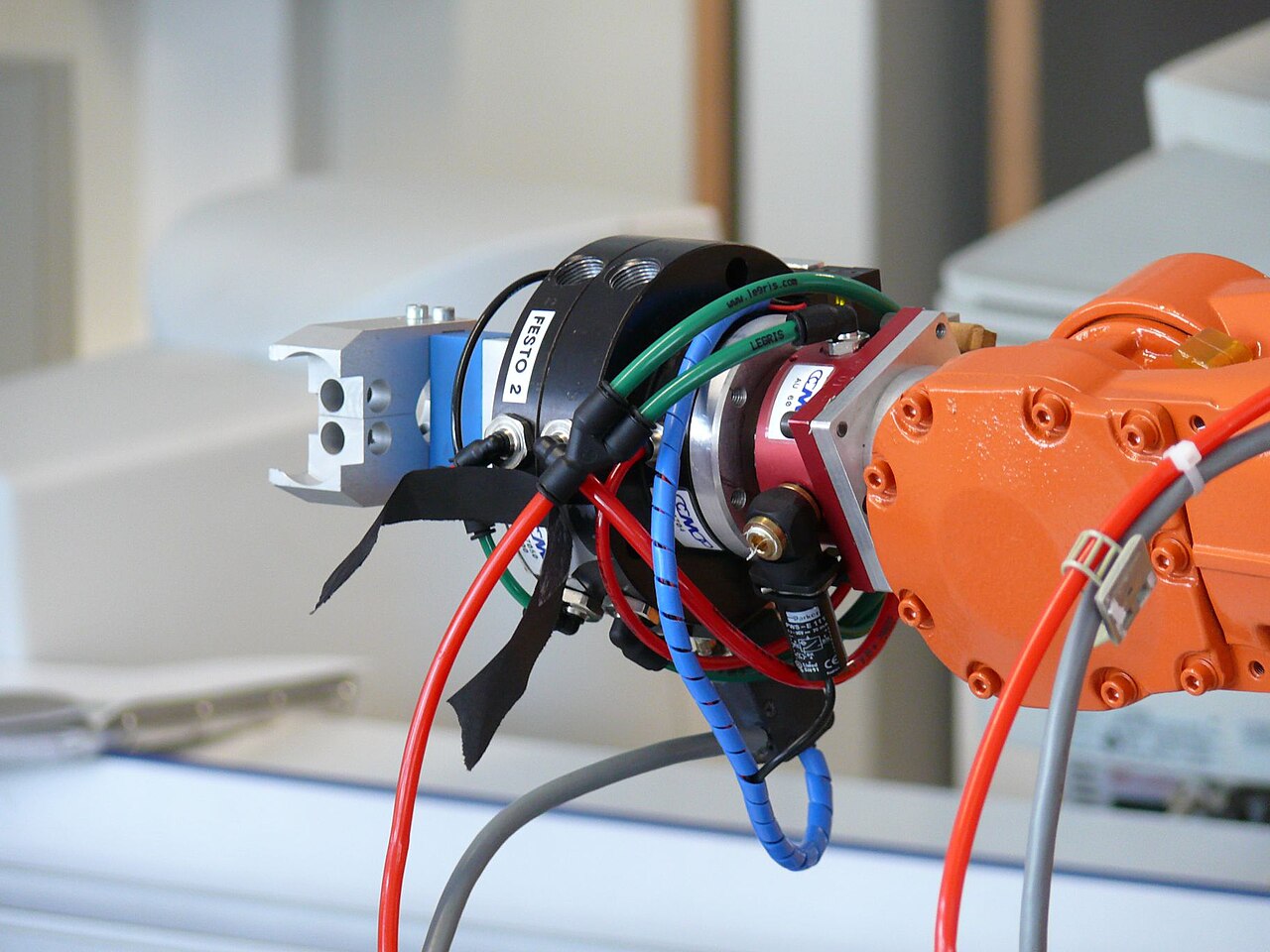
The load diagram is the most important graphic on the sheet. It plots how much the robot may carry as the load's centre of gravity moves away from the mounting flange — and the allowed weight falls, sometimes steeply, with distance. A gripper holding a part at arm's length of tooling can exceed the limit on a robot whose headline payload looks comfortable. Everything on the wrist counts: the tool, any tool changer or sensor, cables dressed along the arm, and the part. The companion figures are the permissible wrist moments, which is where long tools fail specifications that simple weight checks pass. Rule of practice: rate your application against the curve at your real centre of gravity, with margin, never against the headline number.
Reach is a radius; the envelope drawing is the truth
Reach tells you the farthest point the wrist centre can touch. It says nothing about the shape of the space in between. The working-envelope drawing — top and side views with the unreachable zones marked — shows the dead area around the base, the limits imposed by joint ranges, and how mounting position changes everything: a wall- or ceiling-mounted robot works in a different volume than the same arm on the floor. Check your actual stations against the envelope, including approach angles, because a point can be inside the radius and still unreachable at the orientation your process needs.
Repeatability is not accuracy
These two specifications are confused more than any others, and the difference decides applications. Repeatability is how closely the robot returns to a point it was taught — the figure datasheets quote prominently, measured under the ISO 9283 test framework. Absolute accuracy is how closely it moves to a coordinate it was given numerically, and it is typically far worse, because it absorbs every modelling error in the arm's geometry. Taught applications — most welding, handling and assembly — live on repeatability and work beautifully. Offline-programmed applications, where points come from CAD rather than teaching, live on accuracy and may need calibration. If a supplier quotes only one of the two, ask which one your process actually consumes.
Speed ratings and the cycle-time mirage
Axis speeds are quoted per joint, at maximum, unloaded or lightly loaded. Your cycle time depends on the path speed of the tool centre point, acceleration under your real payload, and how much of the move is wrist reorientation. Datasheet cycle claims usually reference a standard short pick-and-place test path; they are useful for comparing models against each other and nearly useless for predicting your line's rate. The honest method is simulation or a vendor cycle study with your payload, your distances and your approach heights — which is why the datasheet reading should end in questions, not conclusions.
The fine print: protection, duty and mounting
Three more lines deserve attention. The IP rating may differ by arm section — a wrist rated for washdown on a body that is not. The duty assumptions behind lifetime figures presume a load and speed profile your application may exceed. And specifications can change with mounting position: an arm rated for floor mounting may derate inverted. None of this is hidden; all of it is printed. It is simply printed in the notes, in smaller type, after the numbers marketing wanted you to compare.
Turning the sheet into RFQ questions
Read this way, a datasheet becomes a question generator: payload at my centre of gravity? envelope at my mounting? accuracy, not repeatability, for my programming method? cycle time with my payload on my path? Those questions belong in the request for quotation itself — our companion guide on how to write an RFQ for a robot shows how to structure them so suppliers answer comparably. For the models themselves, start from the platforms section of the GlobleMatch robotics directory and shortlist by process, then interrogate the sheets.
Frequently asked questions
Why can't my robot lift its rated payload at full reach?
Because the rated payload applies at a limited centre-of-gravity distance from the flange. As the load's centre moves outward, the allowed weight on the load diagram falls. A long tool or a part gripped far from the wrist can exceed the limit well below the headline payload.
Is a more repeatable robot also a more accurate robot?
Not necessarily. Repeatability measures returning to taught points; absolute accuracy measures reaching commanded coordinates and is usually much poorer. Offline programming depends on accuracy, taught applications on repeatability. They are different specifications and must be checked separately.
What reach should I specify for my application?
Work from the working-envelope drawing, not the reach radius. Plot your stations, fixtures and approach orientations inside the envelope, keep margin from the boundary, and check the dead zone near the base. If a station falls near an edge, go one size up rather than hoping.
Which datasheet figure best predicts my cycle time?
None of them directly. Axis top speeds and standard test cycles compare models, but real cycle time depends on path speed, acceleration under your payload and reorientation along your actual path. Ask the supplier for a cycle study or simulation with your parameters.