
Short answer: put RV reducers where torque and shock loads are highest — the base, shoulder and elbow of an industrial arm — and harmonic drives where weight, space and precision matter most — the wrist and the smaller joints. RV (rotary vector) reducers use a cycloidal pin-and-disc mechanism that tolerates impact and holds stiffness under load. Harmonic drives use a flexing spline that delivers high reduction in a very compact, light package with effectively zero backlash. Most six-axis robots use both, each where it belongs.
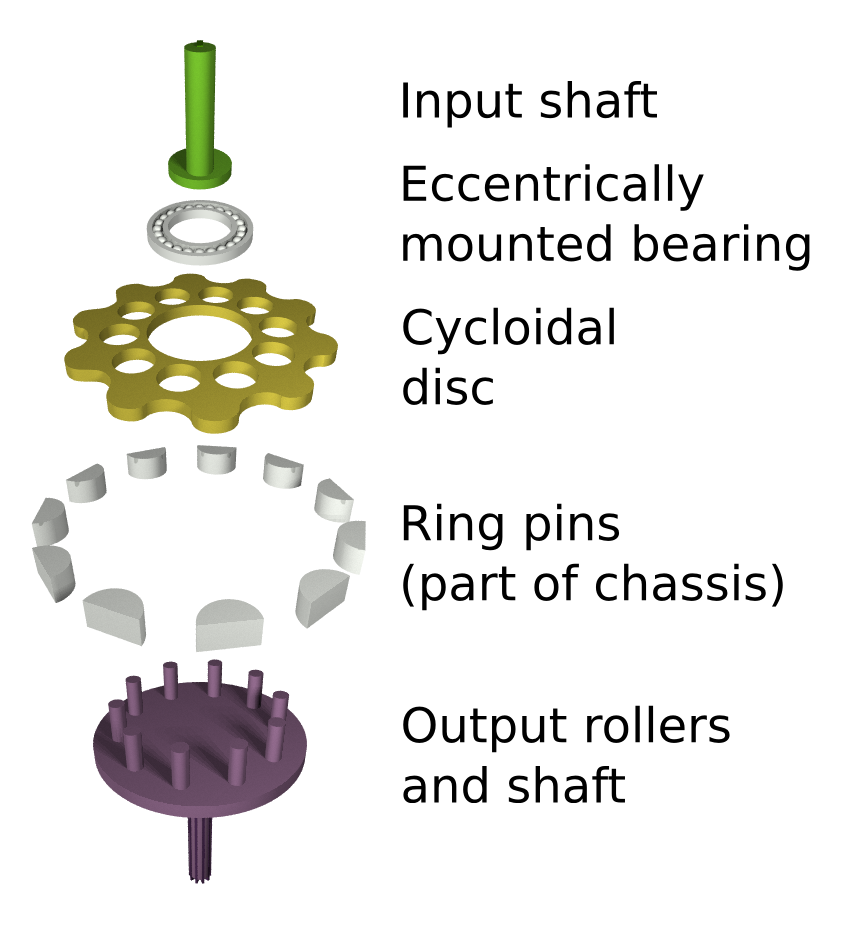
How each one works, in one paragraph each
An RV reducer is a two-stage gearbox: a planetary first stage feeds a cycloidal second stage, in which eccentric shafts drive discs whose teeth mesh with pins around the housing. Many teeth share the load at once, which is why RV units are stiff, shock-tolerant and long-lived — and also heavy, and built to tight machining tolerances that make them the expensive option. Nabtesco is the name most associated with the type; RV reducers sit behind the main axes of a large share of the world's industrial arms.

A harmonic drive (strain wave gear) has three parts: a wave generator that flexes a thin-walled flexible spline inside a rigid circular spline with slightly more teeth. The tooth-count difference produces a large reduction in a short, hollow, light package. Our explainer on harmonic reducers covers the mechanism in depth; the buying-relevant point is that the flexspline is both the genius and the limit — it gives near-zero backlash and compactness, but it is not the component you choose for absorbing repeated shock loads. Harmonic Drive Systems is the category-defining maker, and specialists such as Leaderdrive anchor the supply base listed in the directory's core components category, which counts 160 companies as of 10 November 2026.
The trade-offs that decide selection
| Property | RV reducer | Harmonic drive |
|---|---|---|
| Torque capacity | Very high; suits base joints of large arms | Low to medium; suits wrists and small arms |
| Stiffness under load | High torsional stiffness, minimal wind-up | Lower; flexspline deflects measurably |
| Shock tolerance | Strong — many teeth share impact loads | Limited — flexspline fatigue is the failure mode |
| Backlash | Very low, small hysteresis | Effectively zero backlash by design |
| Weight and size | Heavy and bulky for its ratio | Compact, light, hollow shaft for cabling |
| Cost structure | High; precision machining dominates | Lower at small sizes, rises with diameter |
Selection by joint position
- Base and shoulder (J1–J2): the whole arm's weight and worst shock loads land here. RV is the default in medium and large industrial arms.
- Elbow (J3): contested ground. Larger arms stay with RV; compact arms move to harmonic as torque falls.
- Wrist (J4–J6): harmonic territory. The hollow shaft passes cables, the weight saving compounds at the end of the arm, and torque demands are modest.
- Cobots and humanoid joints: harmonic drives dominate where every gram counts, increasingly packaged inside integrated joint modules; very high-torque humanoid hip and knee joints are where cycloidal designs are being re-examined.
One honest complication: the boundary is blurring at the edges. Planetary gearheads serve lower-ratio axes in both families' territory, and a third cycloidal variant — the fine cycloidal drive — is marketed precisely at the wrist joints harmonic drives own. None of this changes the joint-by-joint logic above; it means the question to a robot maker is never just which type, but which maker's unit, at which joint, with what test data behind it.
What buyers should actually check
Datasheets lead with ratio and rated torque; field life is decided by the less-advertised numbers: torsional stiffness, lost motion over life, and the shock-load rating relative to your emergency-stop and collision cases. Ask which reducer a robot maker uses at each joint and why — the answer reveals how the arm was engineered better than any brochure. And when sourcing reducers themselves, treat claimed equivalence cautiously: the type may be interchangeable on paper while machining quality decides whether the rated life arrives. The core components category in the robotics directory is a starting map of who actually manufactures these parts.
Frequently asked questions
What is the main difference between an RV reducer and a harmonic drive?
The mechanism and therefore the strengths. An RV reducer uses a cycloidal pin-and-disc stage: many teeth share the load, giving high stiffness, high torque capacity and strong shock tolerance at the cost of weight. A harmonic drive flexes a thin spline to achieve reduction in a compact, light, hollow package with effectively zero backlash, but with lower shock tolerance. Robots typically use RV units at base joints and harmonic drives at the wrist.
Which reducer is more accurate?
It depends on the error you care about. Harmonic drives have effectively zero backlash, which suits fine wrist positioning. RV reducers have very low backlash plus much higher torsional stiffness, so under heavy load they deflect less — a loaded base joint can be more accurate with an RV unit even if its no-load backlash figure looks similar. Serious comparisons use lost motion and stiffness curves, not a single backlash number.
Why do most industrial robots use both types?
Because joint loads fall along the arm while precision needs rise. Base joints carry the whole arm and absorb collisions, favouring RV stiffness and shock tolerance. Wrist joints need compactness, low weight and a hollow shaft for cabling, favouring harmonic drives. Splitting the types by joint lets designers buy each property only where it is needed.
Are RV reducers and harmonic drives interchangeable?
Not as drop-in parts. They differ in mounting, shaft interfaces, stiffness behaviour and control tuning, so a joint designed around one type needs redesign to accept the other. At the architecture stage the choice is open; after that, equivalence claims from alternative suppliers should be tested against stiffness, lost motion and shock ratings, not just ratio and torque.