
Short answer: a harmonic reducer (also called a harmonic drive or strain-wave gear) is a compact gearbox that flexes a thin-walled gear inside a rigid ring. Because the flexible gear has slightly fewer teeth than the ring, each motor revolution moves the output by only that small difference — giving a large reduction ratio, near-zero backlash and high precision in a package far smaller and lighter than a conventional gearbox of the same ratio. That combination is why harmonic drives sit inside the wrist, elbow and hand joints of industrial arms, most collaborative robots, and the great majority of humanoid robot joints.
How it works: three parts, one flexing gear
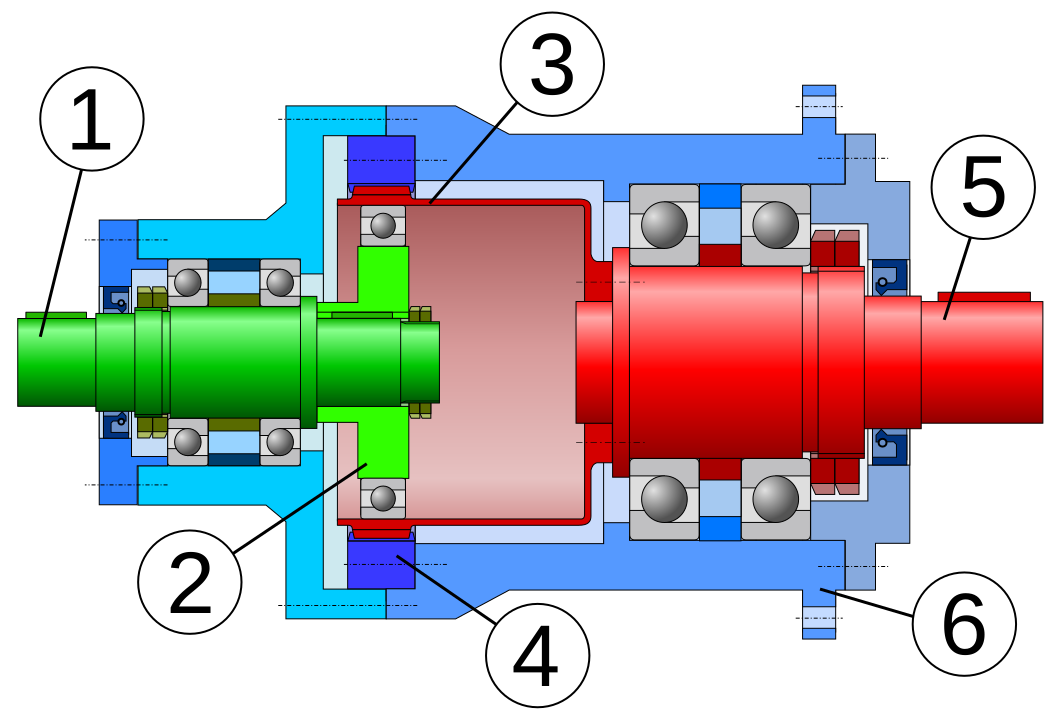
A harmonic reducer has only three functional parts. The wave generator is an elliptical cam with a flexible bearing, connected to the motor shaft. The flexspline is a thin-walled steel cup with teeth cut on its outside; it fits over the wave generator and is flexed into an ellipse. The circular spline is a rigid outer ring with internal teeth — typically two more teeth than the flexspline. When the wave generator rotates, the flexed flexspline meshes with the outer ring at the two ends of the ellipse's long axis. Each full input turn advances the flexspline by exactly the tooth-count difference, so a two-tooth difference on a 160-tooth ring yields a reduction of 80:1 in a single stage. Reduction ratios from roughly 30:1 to several hundred to one are available in the same basic format, and because many teeth are in contact at once, torsional stiffness and positioning accuracy are high for the size.
Harmonic vs RV vs planetary: where each wins
The three reducer families found in robots divide the work by torque and position in the kinematic chain:
| Harmonic drive | RV reducer | Planetary gearbox | |
|---|---|---|---|
| Typical position | Wrist, elbow, hand and other light joints; humanoid joints throughout | Base, shoulder and hip joints of larger robots | Mobile robots, AGV drives, auxiliary axes |
| Backlash | Near zero by design | Very low | Low to moderate; rises with lower-cost grades |
| Torque for its weight | High, but limited absolute torque | Highest absolute torque and stiffness | Moderate |
| Shock tolerance | Limited; overloads damage the flexspline | Strong; the usual choice where impacts occur | Good |
| Single-stage ratio | High (roughly 30:1 and up) | High | Low; multi-stage for high ratios |
The pattern to remember: RV reducers carry the heavy, shock-prone root joints of big arms; harmonic drives take over as joints get smaller and precision matters more than brute torque; planetary gears serve cost-sensitive and mobile applications. Many robots use two or three families at once.
Why the humanoid race runs through this component
A humanoid robot has powered joints throughout its arms, legs, torso and neck, and most of them need exactly what a harmonic drive offers: compactness, low weight and precision. Multiply that per-joint demand by the number of humanoid programmes now publicly pushing toward production — from Figure AI and Unitree to Tesla's Optimus programme — and the reducer becomes one of the most contested parts of the bill of materials. The category is named after its defining company: Japan's Harmonic Drive Systems built the technology into an industry standard, and Chinese makers such as Leaderdrive have grown into significant alternative sources. In the GlobleMatch directory, core components is the second-largest category, with 160 companies listed as of 10 November 2026 — reducers, motors, drives and sensors together.
What actually decides performance in use
Three specifications matter more than the headline ratio. Lost motion and backlash determine how precisely the joint reverses direction — harmonic drives are specified in arc-seconds, and the figure that matters is the one at your working torque, not at rest. Torsional stiffness decides how much the joint deflects under load; a reducer can be backlash-free and still springy. Rated life is quoted at a stated input speed and average torque: the flexspline flexes twice per input revolution, so fatigue life falls quickly when a joint is run hot and overloaded. Buyers comparing two reducers with the same frame size should compare these three numbers at the same conditions before comparing price.
Specifying one: the checks engineers run
- Size from average torque, not peak. Check the load spectrum of the joint: momentary peak torque, average torque and emergency-stop torque each have separate limits in the catalogue.
- Match the format to the joint. Cup-type, hat-type and pancake (component-set) versions exist for different housing arrangements; integrated units with bearings save design time at higher unit cost.
- Verify backlash class. Standard and reduced-backlash grades differ in price; precision assembly and inspection applications need the better grade, simple positioning often does not.
- Ask about life testing. Serious makers publish life-test conditions and can share fatigue data for the size you are buying.
- Plan the second source early. Frame sizes are not standardised across brands; a joint designed around one maker's envelope is expensive to re-source.
If you are mapping the supplier landscape before a design freeze, the core components section of the directory lists reducer, motor and sensor suppliers side by side, each profile compiled from public sources with a last-verified date.
Frequently asked questions
What is a harmonic reducer in simple terms?
It is a compact gearbox with three parts: an elliptical wave generator, a flexible toothed ring (the flexspline) and a rigid outer ring (the circular spline). The wave generator flexes the inner ring so its teeth mesh with the outer ring at two points. Because the flexspline has slightly fewer teeth than the outer ring, each input revolution advances the output by just that small tooth difference — producing a large reduction ratio in a single stage, with almost no backlash.
Harmonic drive or RV reducer — which should a robot joint use?
As a rule of thumb, high-torque base joints (shoulder, hip, the first axes of a large arm) favour RV reducers for stiffness and shock tolerance, while lighter downstream joints (wrist, elbow, hand) favour harmonic drives for low weight and near-zero backlash. Many robots use both, each where it fits.
Why do humanoid robots need so many harmonic reducers?
A humanoid has articulated joints throughout the arms, legs, torso and neck, and most of those joints need a compact, light, precise reducer. Harmonic drives fit that requirement better than bulkier alternatives, so a design with many powered joints multiplies into a large reducer count per robot — which is why the humanoid production race has put so much attention on this one component.
What wears out in a harmonic reducer?
The flexspline flexes on every revolution, so fatigue of the flexspline and wear of its teeth are the main life limits, along with the wave generator bearing. Rated life figures are given at a stated torque and speed; running consistently above rated torque shortens life sharply, which is why honest sizing matters more than the headline ratio.