
Short answer: three documents govern almost every robot purchase. ISO 10218 covers the safety of industrial robots and robot systems — Part 1 for the robot itself, Part 2 for the integrated application, with a major revision of both parts published in 2025. ISO 12100 is the general machinery standard that defines how risk assessments are done. And ISO/TS 15066 is the technical specification for collaborative operation, including the body-region contact limits behind power-and-force limiting. As a buyer you do not apply these standards yourself — you verify that your integrator has, and you collect the paper trail listed at the end of this guide.
The standard under all the others: ISO 12100
ISO 12100 sets the method: identify hazards, estimate and evaluate risk, then reduce it — first by inherently safe design, then by safeguarding, and only lastly by warnings and procedures. Every other document in this guide hangs off that sequence. When an integrator presents a risk assessment, this hierarchy is what you are checking: a cell whose answer to every hazard is "the operator manual says be careful" has the hierarchy upside down.
ISO 10218: the robot and the system
Part 1 of ISO 10218 addresses the robot manufacturer: the safety functions the robot must provide, from emergency stop and protective stop to speed and position limiting. Part 2 addresses the system: the integrated cell, its guarding, its layout and its intended use — the part that lands on your factory floor and therefore on your organisation. The 2025 revision of the standard is the current reference point; when reviewing an integrator's documentation, ask which edition their assessment follows. North American practice runs through the corresponding ANSI/RIA R15.06 standard, which is closely aligned with ISO 10218, while European conformity runs through the Machinery Regulation framework — the underlying engineering is substantially the same conversation.
ISO/TS 15066 and the four collaborative modes
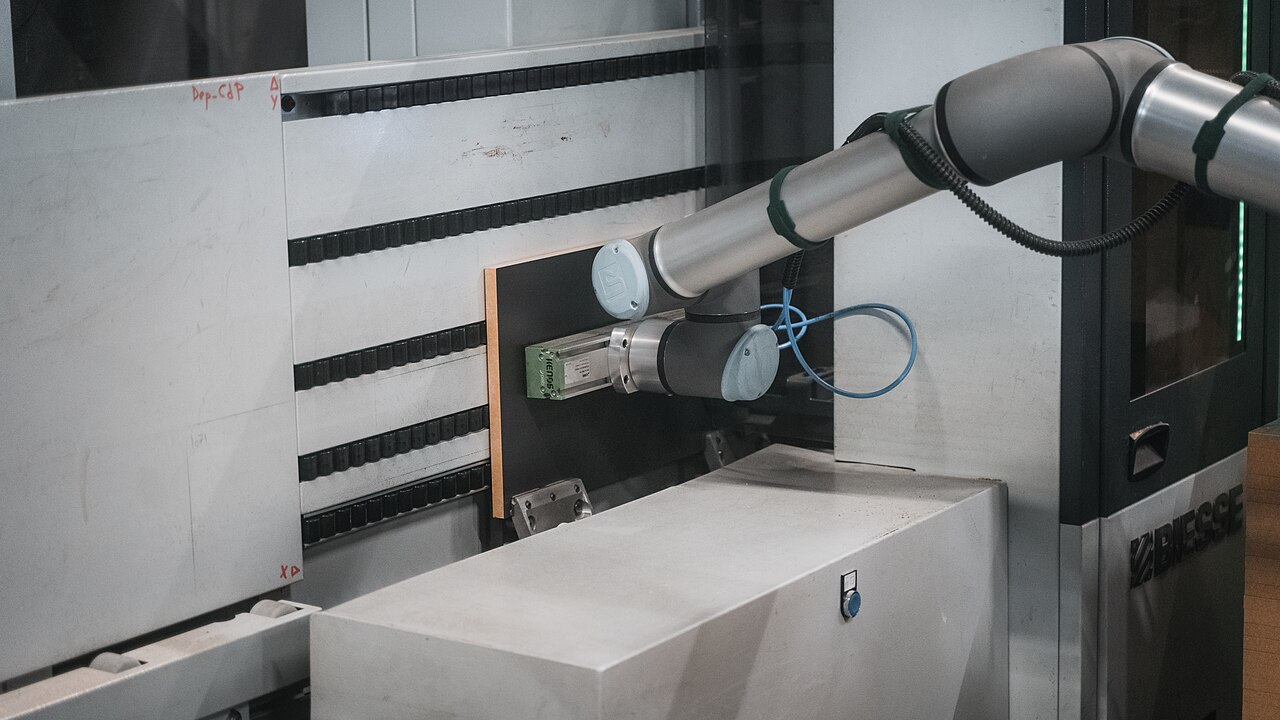
Collaborative operation is not a product category; it is a set of four defined modes that an application can use in combination: safety-rated monitored stop, hand guiding, speed and separation monitoring, and power and force limiting. ISO/TS 15066 details them and — for the last mode — publishes the contact pressure and force limits by body region that make "the robot stops before it can injure" a measurable claim rather than a slogan. This is the document behind every credible cobot deployment: the category itself was proven commercially by pioneers such as Universal Robots, whose arms are built around these functions — but as the FAQ below stresses, a limited-force robot carrying a hazardous tool is still a hazardous application. (Our comparison of cobots and industrial arms covers the selection side; this guide covers the compliance side.)
What a real risk assessment contains
- The task list: every way humans interact with the cell — operation, teaching, cleaning, jam clearing, maintenance — not just automatic running.
- Hazards per task: mechanical, electrical, thermal, ejected parts, stored energy, and the workpiece itself.
- Risk estimation and reduction: severity and likelihood before and after safeguards, following the ISO 12100 hierarchy.
- Residual risks: what remains, and the instructions and training that cover it.
- Validation: evidence the safety functions were tested — stop times, scanner fields, force measurements where the mode requires them.
Questions to ask your integrator before sign-off
- Which edition of ISO 10218 does the assessment follow, and who performed it?
- May we see the risk assessment and the validation records before final payment — not after?
- Which collaborative modes (if any) does this cell rely on, and where are the measurements?
- What changes on our side would void the assessment — tooling, speed, layout, parts?
- Who signs the declaration for the completed system, and in which market's format?
Integrators who do this work daily treat these questions as routine; the directory's system integrator listings include firms whose entire business is delivering cells with exactly this documentation attached. Treat hesitation on paperwork as information about the engineering, because in safety work the document is a deliverable — it is what your insurer, your regulator and your own safety review will ask for after any incident.
Frequently asked questions
Does buying a 'safe' cobot make my application safe?
No. Safety standards evaluate the application — robot, tool, workpiece and task together — not the robot alone. A power-and-force-limited arm carrying a sharp-edged part at head height is still a hazardous application. The robot's built-in safety functions are one input into the application's risk assessment, never a substitute for it.
Who is responsible for the safety of an integrated robot cell?
The party that integrates the robot into the application carries the safety responsibility for the resulting system — typically the system integrator, or the buyer if they integrate it themselves. The robot manufacturer is responsible for the robot as delivered; whoever combines robot, tooling, guarding and process into a working cell owns the risk assessment and the declaration for the whole.
What documents should I receive at handover?
At minimum: the risk assessment for the application, the declaration of conformity or incorporation appropriate to your market, the robot and safety-component certificates, operating and maintenance instructions covering the safety functions, and the validation records showing safety functions were tested as designed. If any item is 'available on request later', treat handover as not yet complete.
When must the risk assessment be redone?
Whenever the application changes in ways that affect hazards: a new or modified tool, a different workpiece (especially heavier, sharper or hotter), higher speeds, changed layout or access, or a new operating mode. A robot cell is certified as a configuration; change the configuration and the assessment — and possibly the safeguards — must change with it.