
A procurement team that begins with a payload ranking risks choosing a machine that cannot reach the fixture, carry the actual tool, or work at the required cycle time. Payload is an important published limit, but it is not a substitute for a complete application study. A useful shortlist starts with the part and end effector, the distance from the robot base to the work point, the expected cycle, and the hazards around the cell. It also helps to separate the broader question of collaborative robots vs traditional industrial arms from the model-level comparison that follows.
The differences between current manufacturer specifications are substantial. Universal Robots describes the UR30 as a 30 kg collaborative robot with a 1,300 mm reach, while listing an extended 35 kg payload configuration. FANUC lists the CRX-10iA at 10 kg and 1,249 mm, and the CRX-10iA/L at 10 kg and 1,418 mm. ABB's IRB 1200 Next Generation family includes configurations from 5 kg at 0.9 m to 9 kg at 0.7 m. These are manufacturer-published product specifications, not independent benchmark results.
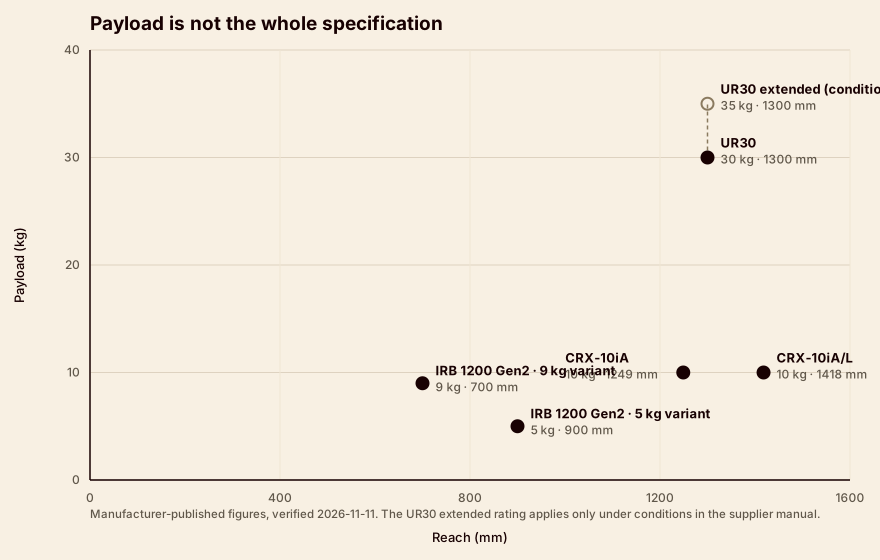
Compare reach and payload together
Imagine two stations: one transfers a compact but heavy workpiece close to the base, while the other handles a light component over a deep conveyor. The first may need more payload; the second may need more reach. Comparing only the kilogram figure would erase the second station's defining constraint. Published reach is also not a promise that every pose in that radius is feasible. Tool geometry, singularities, collision clearance, and joint limits affect whether a proposed motion can be programmed.
For the FANUC CRX models, the official figures make the trade-off concrete. The CRX-10iA has a 1,249 mm reach, while the CRX-10iA/L reaches 1,418 mm; both are listed at 10 kg maximum payload. That is a 169 mm published reach difference, not evidence of a cycle-time advantage. The longer-reach model may be worth evaluating for a particular layout, but buyers still need an application-specific simulation or trial.
The UR30 demonstrates a different procurement question: the official product page specifies a 30 kg standard payload and 35 kg extended payload, alongside 1,300 mm reach. A buyer should not quietly treat the extended number as an unrestricted rating. The supplier's manual and the actual center of gravity, tooling, and operating envelope must be checked before designing around it.
Keep product families and variants separate
The ABB IRB 1200 Next Generation illustrates why directory records should distinguish the product family from individual configurations. ABB lists a 5 kg / 0.9 m variant and a 9 kg / 0.7 m variant, among others. A comparison row that says simply "IRB 1200: 9 kg, 0.9 m" would splice the maximum payload and reach from different variants into a specification the cited page does not claim.
This is a common data-quality trap in industrial catalogs. Product-family marketing pages may advertise "up to" values, but buyers require the pairing of model code, payload, reach, protection, controller, and mounting options. The comparison should preserve variant names in the database, even if the public-facing directory groups them under one manufacturer.
Collaboration is an application property, not a blanket guarantee
"Collaborative robot" describes a product class and potential deployment approach; it does not mean any installation is safe without safeguards. A sharp end effector, a hot part, an unstable load, or a crowded workspace can create hazards regardless of the arm's branding. Buyers should request a documented risk assessment, information about safety functions, and evidence that the complete application — not just the arm — has been evaluated.
The FANUC CRX product page highlights sensitive contact detection and applications such as welding, palletizing, and assembly. Those application examples are not a declaration that every such process can be run without guarding. Welding in particular introduces process hazards beyond contact with the robot.
What an effective request for quotation should contain
A useful RFQ includes a drawing or 3D model of the part, its mass and center of gravity, the proposed gripper mass, pickup and drop-off coordinates, available floor space, target throughput, utility requirements, operating conditions, and the intended human interaction. Buyers should also ask the integrator to identify assumptions and exceptions explicitly. This makes competing proposals easier to compare than a spreadsheet of headline arm ratings. Buyers who do not yet have an integrator can start from the robotics integrators listed in the directory.
The comparison should separate facts from engineering judgments. "Manufacturer lists 1,418 mm reach" is a verifiable fact. "This robot will hit our throughput target" is a hypothesis until cycle testing or simulation supports it. Similarly, repeatability, accuracy, and positioning under load are not interchangeable measures. If a vendor provides only one, leave the others unfilled rather than extrapolating.
For procurement teams without in-house robotics expertise, an integrator's role is especially important. The arm is one component of a system that can include fixtures, vision, grippers, safety equipment, controllers, and maintenance support. A low initial arm price does not establish a low total installed cost. Ask each bidder for a comparable scope of work, acceptance criteria, service terms, and an explicit commissioning plan.
A directory should make uncertainty visible
A credible robotics directory is not a ranking of "best robots." It is a navigable set of sourced claims with enough context for buyers to decide whom to contact. At minimum, a product comparison should expose the model and variant, category, standard payload, conditional or extended payload, reach, source URL, and date of verification. Where an attribute cannot be substantiated, an empty field is more useful than an invented value.
That principle matters as GlobleMatch expands across industrial arms, collaborative robots, grippers, dexterous hands, mobile robots, and other categories. These categories should not be blended into a single payload leaderboard: the purpose and measurement conventions differ. A mobile robot's load capacity and a dexterous hand's grip force are not direct substitutes for an articulated arm's rated payload.
A good buyer journey therefore moves from application to category to qualified suppliers to model-level technical validation. The directory can accelerate discovery, but it should not pretend to replace engineering due diligence. The shortlist is the beginning of the conversation with a supplier, not the end of it.
Sources
- Universal Robots, UR30 official product page: universal-robots.com/products/ur30
- FANUC America, CRX-10iA official product page: fanucamerica.com/products/robot/crx-10ia
- FANUC America, CRX-10iA/L official product page: fanucamerica.com/products/robot/crx-10ia-l
- ABB, IRB 1200 Next Generation official product page: abb.com — IRB 1200 Next Generation
Editorial note: this comparison is limited to published manufacturer claims. No field testing, independent performance benchmarking, pricing verification, or product availability check was conducted.