
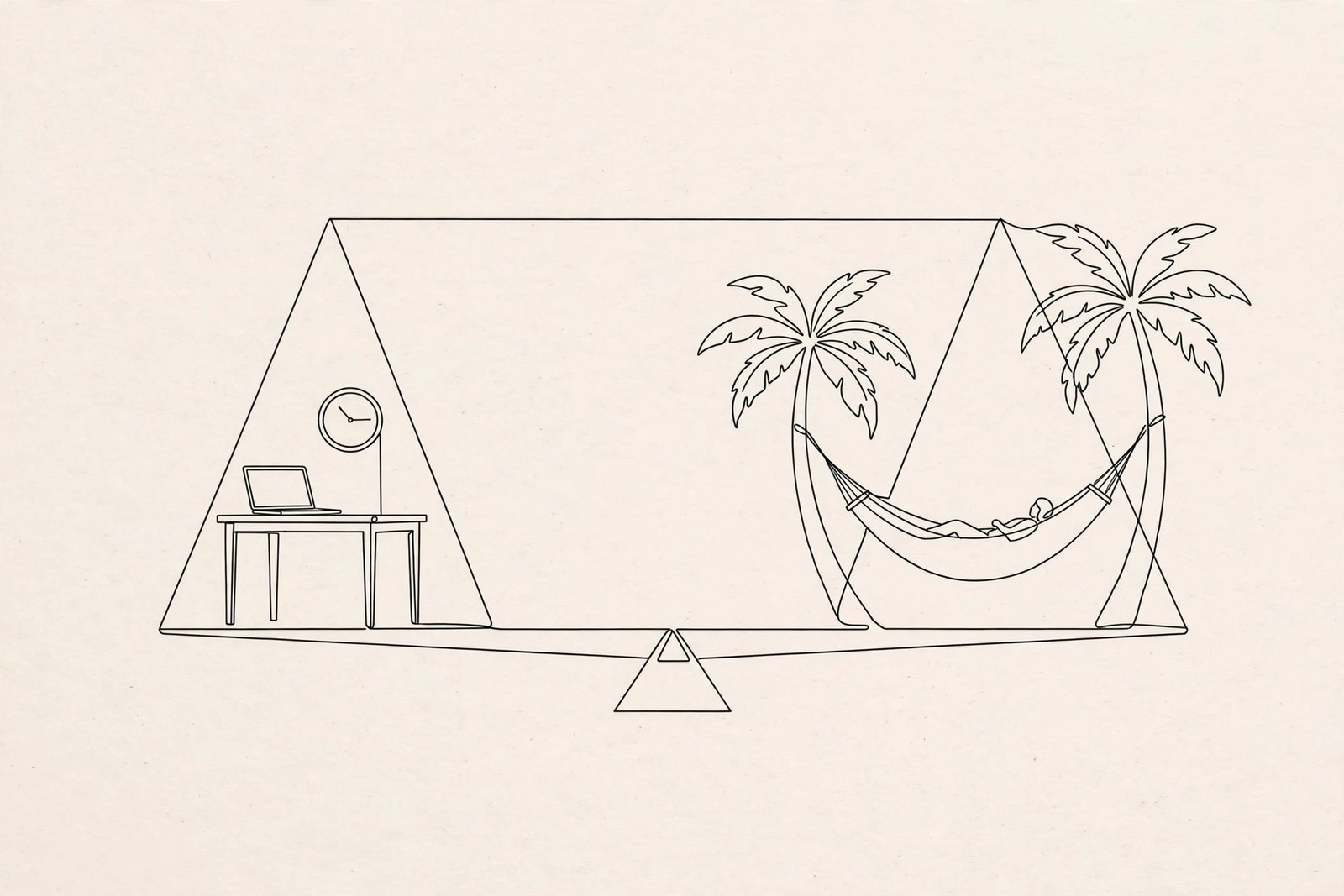
Different rhythms of work and rest
How much we work, how we rest, and how we separate professional and personal life varies enormously across cultures. These differences reflect deeper values about time, ambition, family, and the purpose of work itself.
Understanding them is valuable whether you're working internationally, connecting with friends abroad, or just rethinking your own balance.
Approaches around the world
- Long vacations — many European countries guarantee weeks of paid leave.
- The siesta — midday rest in parts of Spain and Latin America.
- Hustle cultures — long hours and intense dedication in some economies.
- Family-first cultures — work structured around family priorities.
- Disconnect norms — some cultures protect personal time after hours strictly.
What we can learn from each other
There's no single 'right' balance — each culture's approach has strengths and trade-offs. Exposure to other models can inspire healthier habits: the European emphasis on rest, the family-centered priorities of many cultures, or focused dedication where it matters.
When working or connecting across cultures, respect different norms around availability and time off. Learn about cultural concepts of time in our Concept of Time lesson and explore Country Guides for local rhythms.
The spectrum: from long lunches to always-on
How much of life should work consume? The world's answers span an astonishing range. In much of Southern Europe, the midday break remains sacred — long lunches, shops closed in the afternoon, evenings that stretch late because the day was properly punctuated. France legally protects the right to disconnect: companies above a certain size must negotiate after-hours email boundaries. The Nordic countries pair high productivity with some of the world's most generous parental leave and flexible working norms — the assumption being that a rested worker is a better worker.
At the other end, East Asian work cultures have historically prized long hours and visible dedication, though younger generations are increasingly pushing back and governments are experimenting with reforms. The United States combines high productivity with minimal guaranteed vacation — many workers leave paid days unused, a phenomenon rare elsewhere. Latin America and parts of Southern Europe treat family events and festivals as non-negotiable calendar items that work bends around, not the reverse. None of these models is purely better — each reflects deep values about ambition, community, security, and what a good life looks like. But seeing the spectrum is liberating: your culture's way is a choice, not a law of nature.
What the balanced cultures get right
Look closely at the cultures known for balance and a few principles emerge. First, boundaries are treated as productive, not lazy. The French lunch break, the Swedish fika, the Spanish evening stroll — these are not indulgences but infrastructure, the recovery time that makes focused work possible. Research on human performance consistently supports what these cultures intuited: sustained overwork degrades the quality it claims to maximize.
Second, vacation is a norm, not a negotiation. In much of Europe, taking four to six weeks off is simply what people do — colleagues cover for each other without resentment because everyone gets their turn. Compare this with cultures where long vacations signal low commitment, and you see how powerfully norms shape behavior. Third, identity is diversified: in balanced cultures, "what do you do?" is a less defining question. People are parents, musicians, hikers, volunteers — work is one thread among many, which makes both work stress and job loss less existentially threatening. Our slow travel guide explores what happens when you apply this diversification to how you spend your time.
Borrow the best: practices you can adopt anywhere
You do not need to move to Copenhagen to steal the good ideas. Start with the real lunch break: step away from the desk, eat without screens, take a short walk. This single habit — normal across Southern Europe — measurably improves afternoon focus and mood. Next, create a shutdown ritual: a specific action that ends the workday — closing the laptop and changing clothes, a walk around the block, ten minutes of music. The ritual trains your brain that work is over, which is exactly what the French right-to-disconnect laws try to institutionalize.
Adopt fika — the Swedish twice-daily coffee break, taken with colleagues, without agenda (our tea and coffee rituals guide covers it). Fifteen minutes of genuine social pause beats an hour of desk-snacking. Take your vacation days — all of them — and take them properly: out of office means out of inbox. And diversify your identity deliberately: one non-work commitment that matters to you, protected on the calendar like a meeting with your most important client. You cannot import another culture's labor laws, but you can import its wisdom: work is a part of life, and a part is not the whole.
Watch the four-day week experiments with interest, wherever you land on them. Trials run by companies and public bodies in several countries have drawn wide attention, with participating organizations reporting maintained output alongside improved wellbeing — though researchers note the results depend heavily on how the extra day off is implemented. You do not need to wait for policy: try a personal version by ruthlessly protecting one weekday evening or a meeting-free Friday afternoon and measuring what actually suffers. Most people discover the suffering is minimal and the recovery is real. Whether or not the four-day week becomes the global norm, its popularity signals something important — a growing collective suspicion that the way we currently work is not the only way, or the best one.