
Short answer: Depalletising and piece picking fail or succeed on perception, not on the robot. The system must find each item's position and orientation on a pallet or in a stream, decide a safe grasp, and do it at line speed on packaging that was never designed for machines. The working recipe is consistent: 3D imaging of the whole load, software that separates the load into graspable items and sequences them, a gripper chosen for the packaging range, and a designed path for the items the system cannot handle.
Two problems wearing one name
Depalletising works from a structured stack: layers of cases, often uniform per layer, where the challenge is finding layer boundaries, damaged or shifted cases, and a removal order that keeps the stack stable. Piece picking works from disorder: single items in totes, on belts or in chutes, in the variety of an e-commerce catalogue. The vision and gripper demands differ enough that suppliers specialise; a vendor strong in case depalletising is not automatically a piece-picking vendor. Our guide to bin picking covers the manufacturing cousin of the piece-picking problem, and the camera technology choices behind both are compared in the vision section of the directory.
Scanning the load and cutting it into layers
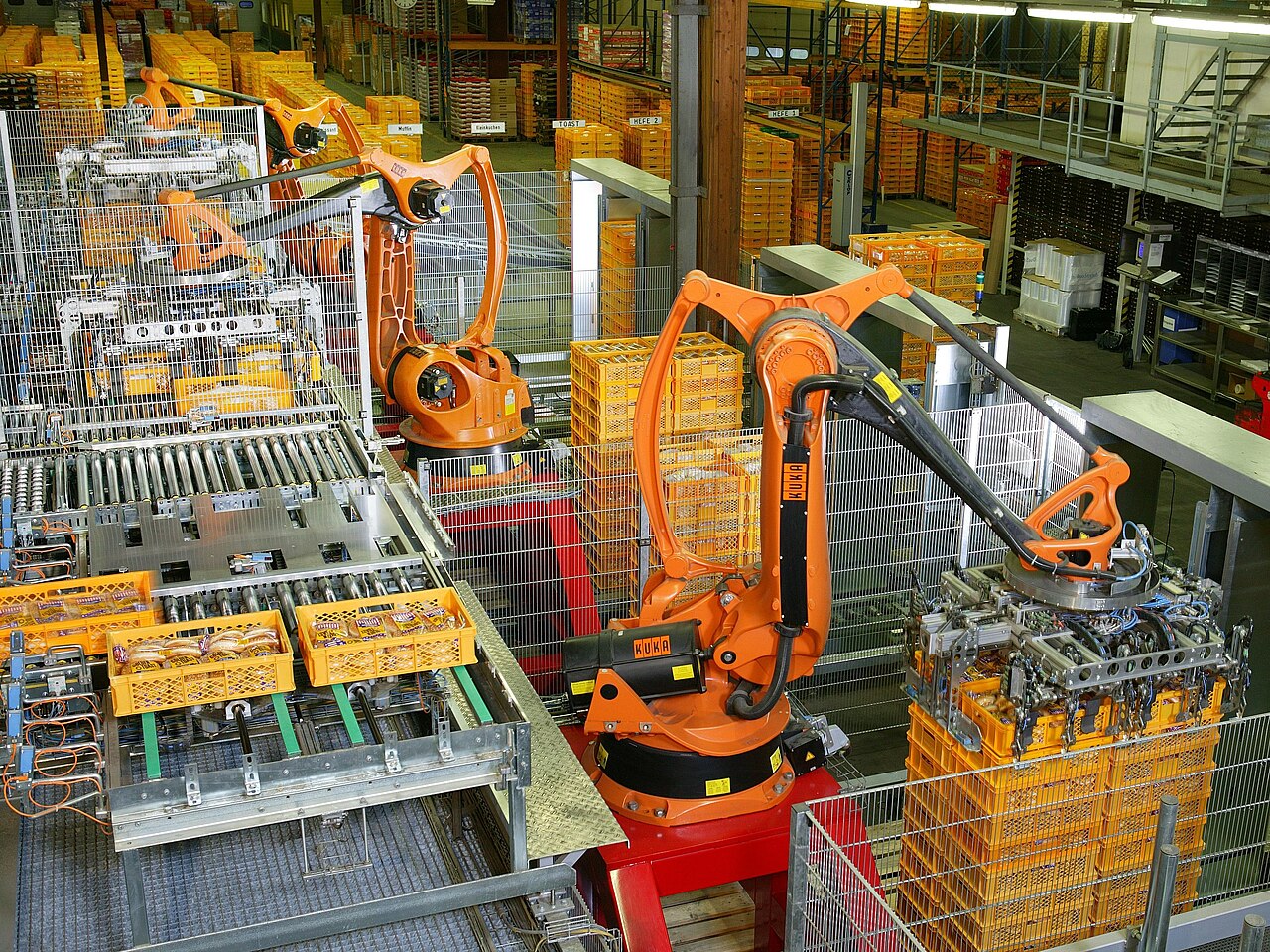
A depalletising cell starts by imaging the entire pallet, usually with a fixed 3D camera above or beside the stack. Software reconstructs the load's geometry, identifies individual cases from edges and seams, and plans a removal sequence — typically top layer first, outside-in, keeping the remaining stack stable and the gripper's approach paths clear. Mixed-SKU pallets raise the difficulty sharply: case sizes vary within a layer, labels and tape confuse edge detection, and a shifted case can lean on its neighbour. The honest measure of a system is not its demonstration pallet but its behaviour on the worst pallet your operation actually receives — crushed corners, stretch-wrap glare and all.
Boxes, bags and the items in between
Packaging decides the gripper and the vision settings. Rigid cases are the friendly case: flat faces for vacuum or clamp grippers, clean geometry for the camera. Bags and pouches deform under grip, present no stable edges, and defeat simple box-finding; they want area grippers and software that models a surface rather than a cuboid. Bottles, tubes and glossy retail packaging add specular reflections that blind naive 3D sensing. A supplier evaluation should therefore be run on your packaging distribution — the top twenty SKUs by volume plus the known troublemakers — not on the supplier's demonstration set. This is the same discipline the wider warehouse automation picture applies to sorting and packing: evaluate the cell on your flow, at your mix.
Matching the line's takt
A depalletising or picking cell is one station in a flow, and its rated rate means little alone. What matters is sustained throughput at your item mix, including the time lost to re-grasps, exception diversions and pallet or tote changes — matched against the conveyor, AMR supply or packing stations it feeds. Oversizing the cell wastes capital; undersizing makes it the line's permanent bottleneck. The design conversation should produce a rate budget for the whole flow, with the vision cell's contribution stated at a realistic success rate, not at the camera's frame rate.
Design the exception path, then measure honestly
Every real system meets items it cannot pick: crushed, tangled, transparent, out of catalogue. The difference between a working installation and a stalled one is whether those items have a designed route — a diversion lane to a staffed station, with the flow continuing — or whether they stop the cell for a human rescue. Build the exception path into the layout and the staffing plan from the start. Then contract on measurable acceptance: pick success rate by item class, sustained picks per hour over full shifts, damage rate, and exception rate, all measured on your goods. A supplier who welcomes those terms is telling you the same thing as one who resists them.
Frequently asked questions
What is the difference between depalletising and piece picking?
Depalletising empties a structured stack — layers of cases on a pallet — where the work is finding layer boundaries and a stable removal order. Piece picking singulates individual items from disorder, as in e-commerce totes. They use related vision and grippers but are different engineering problems, and suppliers often specialise in one.
Why do depalletising systems struggle with mixed pallets?
Uniform layers present predictable geometry; mixed pallets vary case sizes within a layer, hide edges under tape and wrap, and lean shifted cases against each other. The vision system must reconstruct individual items from imperfect evidence, which is why evaluation should use the worst pallets an operation actually receives.
What gripper works for both boxes and bags?
No single gripper is best at both. Rigid cases suit vacuum heads and clamps; deformable bags want area grippers that support the whole surface. Cells handling both usually combine a zoned vacuum/area head or carry two tools with a changer — the packaging distribution decides.
How should a depalletising cell be accepted?
On measured performance with the buyer's own goods: pick success rate by item class, sustained throughput across full shifts including exceptions, damage rate, and the share of items diverted to the manual exception path. Rates quoted on a supplier's demonstration set are not acceptance evidence.