
Germany rewards buyers who source robotics components there. The country runs the largest robot market in Europe, supports a dense supplier base organized around components and systems, and exports automation know-how along with hardware. This guide explains what the German robotics components ecosystem looks like, which component categories buyers typically source there, how the procurement process works in practice, and how to use GlobleMatch to reach German suppliers.
Why Germany is a serious sourcing market for robotics components
Start with the demand side. According to the International Federation of Robotics (IFR), Germany installed 26,982 industrial robots in 2024. That made it the largest robot market in Europe and the fifth-largest in the world, accounting for 32 percent of all European installations in a year when Europe as a whole installed 85,000 units.
Installed base matters as much as new sales, because a large working fleet creates ongoing demand for spare parts, retrofits and upgrades. The IFR puts Germany's robot density at 449 robots per 10,000 manufacturing employees in 2024, the third-highest figure worldwide behind the Republic of Korea (1,220) and Singapore (818). German density has grown by 5 percent per year since 2019, and it sits well above the Western European average of 267 and the EU-27 average of 231.
How the German components ecosystem is organized
The supplier landscape is structured by the VDMA Robotics + Automation association, the robotics trade association within the VDMA, Germany's mechanical engineering federation. The association counts more than 400 member companies, and its own description of the membership is a useful map of the ecosystem: its members are suppliers of components and systems in three fields — robotics, integrated assembly solutions and machine vision.
The three fields also show where the money is. In its June 2025 forecast, VDMA Robotics + Automation expected the German robotics and automation industry to generate €14.5 billion in total sales in 2025. Within that total, machine vision accounted for €3.1 billion, robotics for €3.7 billion and automated solutions for €7.7 billion. For a buyer, the practical lesson is that Germany does not just assemble finished robots: it has deep, separately organized industries for the vision systems, assembly technology and components that surround the robot arm itself.
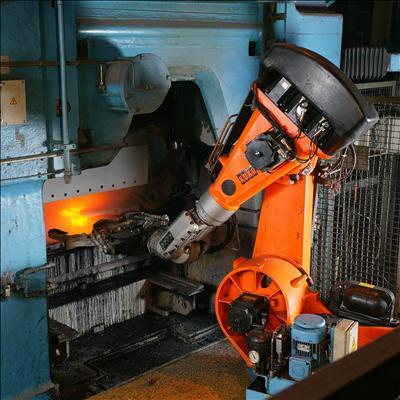
One prominent name in the landscape is KUKA, the automation group whose headquarters are in Augsburg, Germany. KUKA sells complete industrial robots in a wide range of payload capacities and reaches, production machines and full production systems, and component buyers meet its ecosystem of integrators and suppliers across the country. The point for sourcing is not the brand itself but what sits behind it: a home market large enough to sustain specialized component makers at every layer of the robot stack.
What buyers source from Germany, category by category
Component sourcing from Germany usually falls into the following categories. The descriptions below reflect how the VDMA groups its component and system suppliers, and what each category has to prove before it earns a place in a robot.
Precision gearboxes and reducers. Harmonic, cycloidal and planetary reducers set a robot's accuracy, backlash and service life, which makes them a technically demanding part of the stack. Buyers should ask for rated torque, torsional stiffness, backlash figures over life, and the test data behind them.
Servo motors and drives. The servo package determines how smoothly and repeatably a joint moves. When sourcing motors, drives and feedback encoders, match the electrical interface and control protocol to your controller early; a mechanically perfect motor that cannot talk to your drive is an expensive paperweight.
Sensors and safety components. Force-torque sensors, proximity and position sensors, encoders and safety-rated scanners are the components that let a robot work near people and delicate parts. Ask about the safety standards each component is designed to meet, and request the certificates rather than a summary of them.
Machine vision. Cameras, optics, lighting and vision software form a German industry in their own right — the €3.1 billion subsector in the VDMA forecast above — organized as one of the association's three sector groups. Vision is often sourced separately from the robot itself, and buyers should test suppliers with their own parts and lighting conditions, not the supplier's demo pieces.
End effectors, cables and control components. Grippers, tool changers, dress packs and control cabinets rarely make headlines, but they decide how much downtime a cell has. German suppliers in the VDMA's integrated assembly solutions field cover much of this layer, and buyers should source wear parts and spares with the same care as the headline components.
The sourcing process, step by step
1. Write the specification around the joint, not the catalogue. Define payload, reach, repeatability, duty cycle, environment and the standards your end market requires. German component suppliers engineer to specification; a precise brief gets a precise quotation, and a vague one gets a telephone call.
2. Build a longlist from structured sources. Industry directories, the VDMA's member landscape and trade fairs such as automatica in Munich — which VDMA Robotics + Automation sponsors as its conceptual and technical sponsor — are the standard starting points. Trade fairs matter in this industry because components can be inspected, compared and discussed with the engineers who designed them.
3. Qualify before you negotiate price. Ask for datasheets, test reports, reference customers in your industry, and the component's certification file. Then run samples on your own rig. German suppliers expect this sequence and respect buyers who follow it; skipping qualification to save two weeks is how projects lose two quarters.
4. Agree commercial terms like an engineer. Cover Incoterms, delivery windows, spare-parts availability, firmware and documentation language, and what happens when a component is revised or discontinued. For components that will sit inside your product for a decade, the revision and end-of-life clauses matter as much as the unit price.
5. Pilot, then scale. Start with a pilot quantity in one cell or one product variant, measure failure rates and support responsiveness, and only then commit to volume. Keep a second source qualified for any component whose failure would stop your line.
Sourcing German robotics components through GlobleMatch
GlobleMatch is a business directory and matching service for cross-border sourcing, and German robotics suppliers are part of its directory. The process is simple: post a sourcing request describing the component, the specification and the quantity you need. Posting a request is free for buyers. GlobleMatch introduces matching suppliers based on fit with the request — introductions are chosen by matching, not sold, and no supplier can pay for ranking or placement in the results. You then deal with the suppliers directly, run the qualification steps above, and negotiate your own terms.
Conclusion
Sourcing robotics components from Germany works best when you treat it as an engineering exercise with a commercial wrapper: specify precisely, qualify rigorously, and use the country's structured supplier landscape — its association, its fairs and directories such as GlobleMatch — to reach specialists you would not find from a search engine alone. The depth is there; the buyers who benefit are the ones who arrive with a serious brief.
Frequently asked questions
Why source components from Germany instead of buying a complete robot?
Because the value in a robot sits in its components — reducers, servos, sensors and vision decide accuracy, uptime and safety. Germany's supplier base is organized around exactly those layers, and its home market, the largest in Europe, keeps specialists in each layer busy enough to stay sharp.
Do German suppliers work with smaller buyers?
Many do, especially component specialists whose business is selling parts rather than turnkey lines. A precise specification, a realistic pilot quantity and a clear path to volume matter more than the size of your first order.
How much does it cost to post a sourcing request on GlobleMatch?
Nothing. Posting is free for buyers, and introductions are made by fit. Suppliers cannot pay to be ranked higher or placed in front of you.
Sources
International Federation of Robotics, World Robotics 2025 press release (Germany: 26,982 installations in 2024, largest market in Europe, fifth-largest worldwide, 32 percent of the European total; Europe: 85,000 installations): https://ifr.org/ifr-press-releases/news/global-robot-demand-in-factories-doubles-over-10-years
International Federation of Robotics, robot density press release, April 2026 (Germany: 449 robots per 10,000 manufacturing employees in 2024, third worldwide; Republic of Korea 1,220; Singapore 818; Western Europe 267; EU-27 231; German density growth of 5 percent per year since 2019): https://ifr.org/ifr-press-releases/news/robot-density-surges-in-europe-asia-and-americas
VDMA Robotics + Automation, association page (three sector groups: Robotics, Machine Vision, Automated Solutions; more than 400 member companies, described as suppliers of components and systems; sponsor of automatica): https://www.vdma.eu/en/robotics-automation
VDMA Robotics + Automation, Forecast 2025 press release, June 2, 2025 (total sales of €14.5 billion expected in 2025; machine vision €3.1 billion; robotics €3.7 billion; automated solutions €7.7 billion): https://www.businesswire.com/news/home/20250602268769/en/VDMA-Forecast-2025-German-Robotics-and-Automation-Faces-Ten-Percent-Revenue-Drop
KUKA, locations page (headquarters in Augsburg, Germany): https://www.kuka.com/en-us/company/kuka-locations
KUKA, official website (industrial robots in a range of payload capacities and reaches, production machines, production systems): https://www.kuka.com
Image credits
Image: Factory automation with industrial robots for metal die casting in a foundry — Public domain, by KUKA Roboter GmbH, via Wikimedia Commons
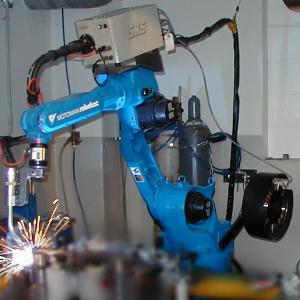
Image: Articulated-arm industrial robot with a welding torch — Public domain, by H. Weihe, via Wikimedia Commons
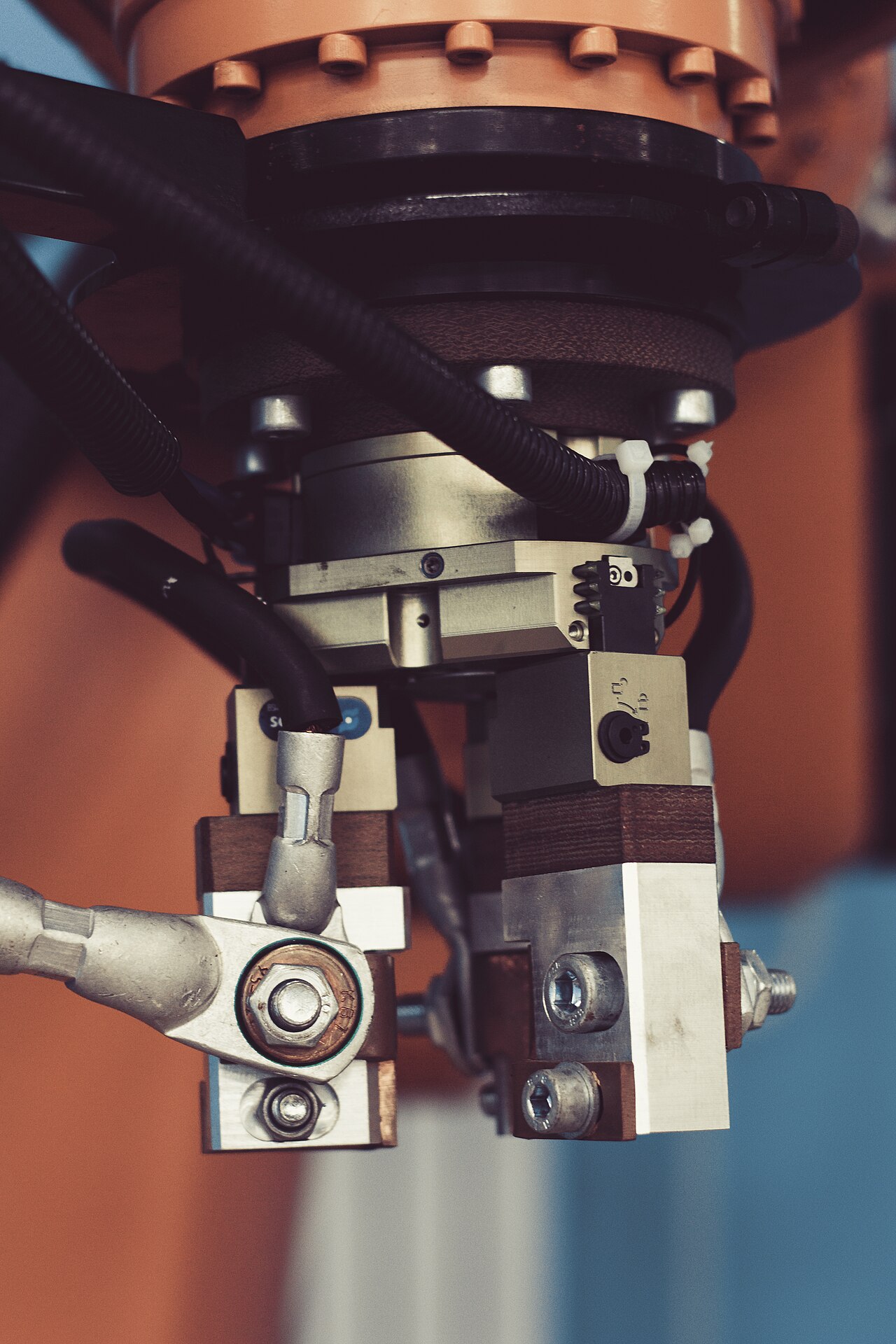
Image: KUKA robot, close view — CC BY 4.0, Aleksey Chetverukhin, via Wikimedia Commons