
Short answer: An encoder is the sensor that converts a shaft's rotation into electrical counts the controller can read — it is how a robot knows where each joint actually is. The choices that matter are incremental versus absolute (does the joint know its position at power-up?), single-turn versus multi-turn (does it count whole revolutions?), and resolution versus accuracy (fine counts are not the same as true ones). Most other buying questions are consequences of those three.
Incremental vs absolute: the power-up question
An incremental encoder emits pulses as the shaft turns; the controller counts them from a reference point. The design is simple, fast and cheap — but at power-up the count is unknown, so the robot must perform a homing move to find its reference before it knows where it is. An absolute encoder reports the shaft's position directly, as a digital word, the moment it is powered: no homing, and no lost position after a power cut. That difference decides behaviour in exactly the situations factories care about — restarting mid-shift, recovering from an e-stop, resuming after a fault. It is also the core of the encoder discussion inside servo selection, which our servo motor guide covers from the motor side.
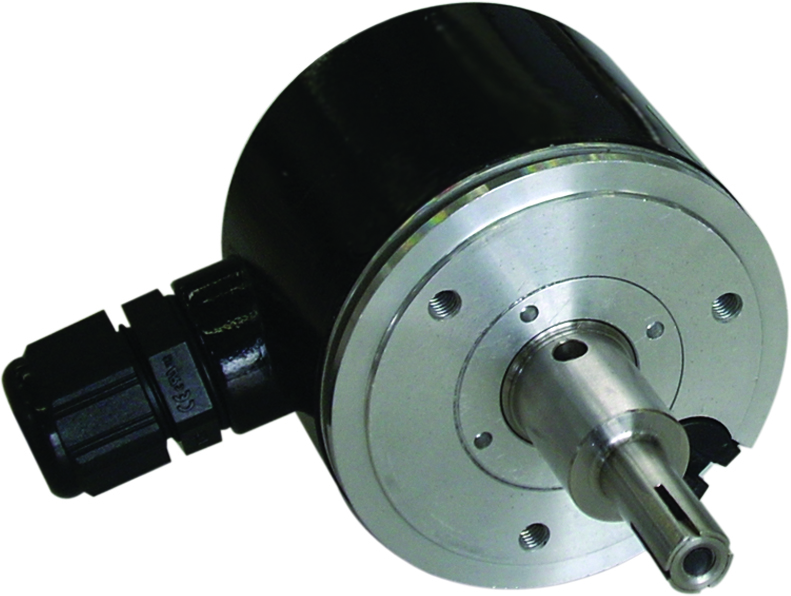
Single-turn, multi-turn and the battery question
A single-turn absolute encoder knows the position within one revolution — but a robot joint behind a gearbox turns its motor shaft many times per joint movement, so most robot axes need multi-turn counting: the encoder also tracks how many whole turns have accumulated. Designs differ in how they keep that count. Battery-backed encoders remember turns while powered down and eventually need a battery change — a scheduled maintenance item that becomes a line-down fault if it is forgotten. Gear-based and energy-harvesting designs count turns mechanically or from the motion itself and avoid the battery entirely. When comparing robots or spare motors, ask which design is fitted; it predicts a maintenance task years in advance.
Resolution is not accuracy
Resolution is the smallest movement the encoder can report, quoted in bits or counts per turn, and it improves every product generation. Accuracy is how close the reported position is to the true one, and it is limited by disc or scale quality, mounting eccentricity, bearing play and temperature. A high-resolution encoder mounted slightly off-centre produces finely counted, systematically wrong positions — which the controller then repeats faithfully. For buyers the practical consequence: repeatability figures for a complete robot (mechanics included) mean more than the encoder's headline bit count, and calibration — mastering the robot against a known reference — is what converts encoder counts into usable accuracy. It is also why two robots quoting identical encoder specifications can post different real-world repeatability: the encoder is only one term in a mechanical equation that includes gearing, structure and thermal behaviour.
Optical, magnetic and inductive designs
Optical encoders read a patterned disc with light: the highest resolutions and accuracies, and the most sensitivity to contamination and condensation. Magnetic encoders read a magnetised ring or scale: slightly coarser at the top end, but tolerant of dust, oil mist and vibration, which is why they dominate compact joint modules. Inductive and capacitive designs sit between, trading precision for robustness in harsh environments. The selection logic mirrors the rest of the components section of the directory: match the sensing principle to the environment the joint actually lives in, not to the best number in a catalogue.
Failure modes and the spares strategy
Encoders fail in characteristic ways: contaminated optical discs produce intermittent count errors; cables and connectors at the joint — flexed millions of times — break before the sensor does; battery-backed multi-turn units lose their turn count when the battery dies, and the axis then reports a plausible but wrong position. The operational rules follow. Treat encoder error codes as stop-and-diagnose events, not clear-and-restart events. Keep the mastering procedure and its reference marks documented, because re-mastering after a motor or encoder swap is the step that restores accuracy. And hold spares at the level of the motor-encoder assembly for the axes whose failure stops the line: an encoder alone is rarely a field-swappable item, and the cheap part is not the one that decides downtime.
Frequently asked questions
What does an encoder do in a robot?
It converts the rotation of each joint's motor shaft into position counts the controller can read. Every motion command, accuracy figure and safety position check in the robot ultimately rests on those counts being present and correct.
What is the difference between incremental and absolute encoders?
An incremental encoder only counts movement from a reference, so the robot must home itself after power-up before it knows where it is. An absolute encoder reports its position immediately at power-up, including after a power cut, which makes restarts and fault recovery faster and simpler.
Is a higher-resolution encoder always better?
No. Resolution says how finely position is counted; accuracy says how true the count is, and it is limited by mounting, bearings and temperature. For a complete robot, the machine's tested repeatability matters more than the encoder's bit count.
Why do some robots need their encoder batteries replaced?
Battery-backed multi-turn encoders use a battery to remember whole shaft revolutions while the power is off. When the battery dies, the turn count is lost and the axis position becomes wrong. The replacement is a planned maintenance item — the failure only happens when the plan is ignored.