
Short answer: the difference between an AMR (autonomous mobile robot) and an AGV (automated guided vehicle) is how it finds its way. An AGV follows guidance installed in or on the floor — magnetic tape, wires, reflectors or floor codes — along fixed routes. An AMR carries its own sensors and mapping, builds a picture of the building, and plans and re-plans routes around obstacles. That single difference drives everything else: AGVs are simpler and proven on stable, high-volume loops; AMRs cost less to install, adapt when layouts change, and share space with people more gracefully.
How each one navigates
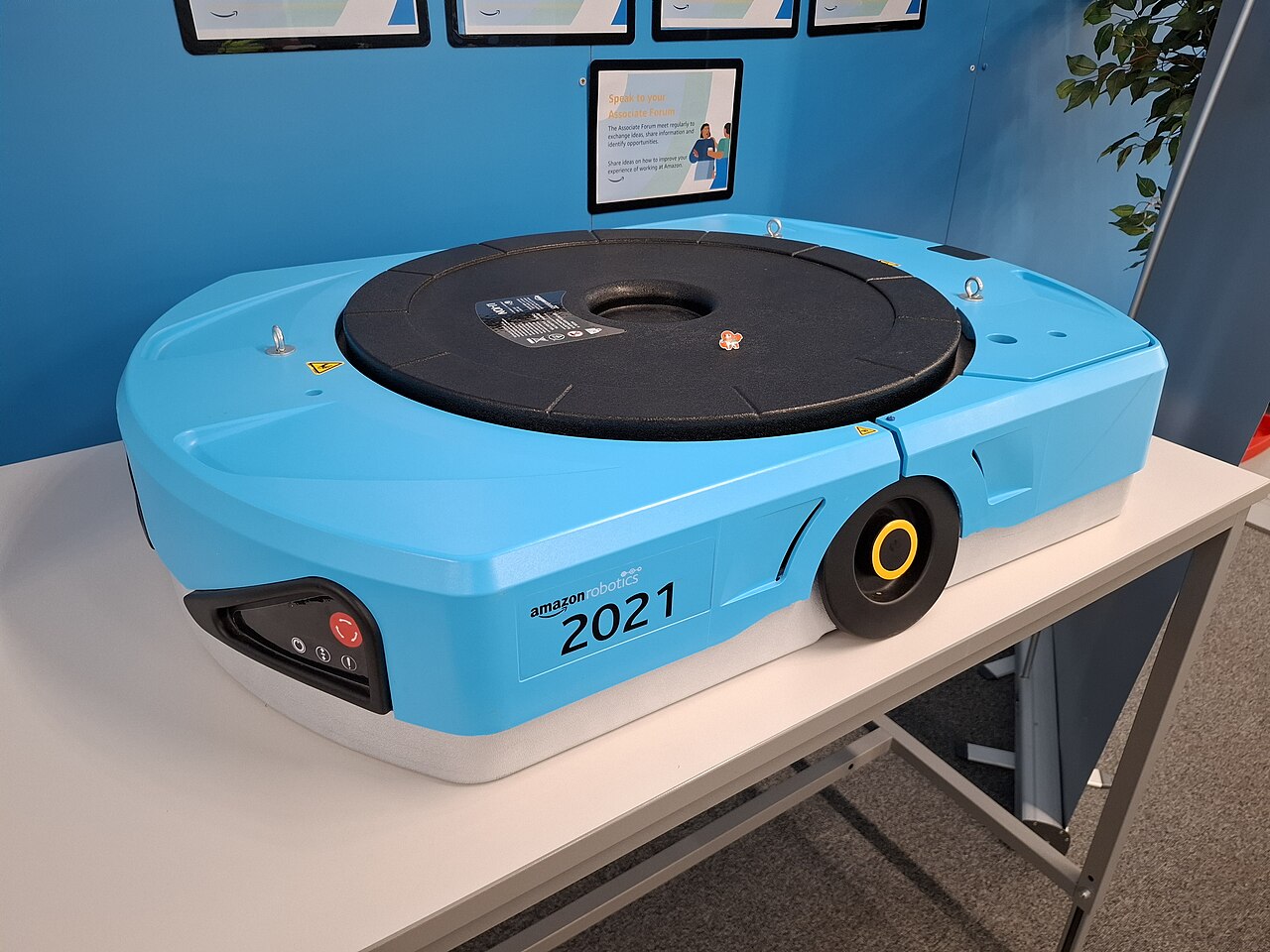
An AGV's intelligence lives in the infrastructure. The vehicle is comparatively simple; the route is defined by the guidance line, and stops, turns and charging points are fixed in advance. Changing a route means changing the floor. An AMR's intelligence lives on board: lidar, cameras and sometimes 3D sensors feed a map (usually built with SLAM — simultaneous localisation and mapping), and a fleet manager assigns jobs and manages traffic between robots. Changing a route is a software edit. Amazon's warehouse robotics began with the other model — Amazon acquired Kiva Systems in 2012, in a deal reported at $775 million, and scaled fixed-infrastructure goods-to-person systems before the industry's centre of gravity shifted toward autonomous navigation.
| AGV | AMR | |
|---|---|---|
| Navigation | Fixed guidance: tape, wire, reflectors, floor codes | Onboard sensing and mapping; free navigation |
| Changing a route | Physical work on the floor | Software change in the fleet manager |
| Meeting an obstacle | Stops and waits | Routes around it, within its map |
| Site modification | Guidance installation on every route | Minimal; sometimes reflectors or markers only |
| Best environment | Stable layouts, fixed loops, heavy predictable flows | Changing layouts, mixed human traffic, phased rollouts |
| Typical strength | Simplicity, heavy payloads, decades of references | Flexibility, fast deployment, granular scaling |
Where AGVs still win
If your building runs the same loop ten thousand times — pallets from receiving to a fixed storage interface, parts from warehouse to line side — an AGV's simplicity is a feature. The vehicles are mechanically straightforward, the behaviour is perfectly predictable, and heavy-payload AGVs have a long reference history in automotive and manufacturing plants. When the route will not change for years, paying for onboard autonomy buys flexibility you will never use.
Where AMRs win
AMRs earn their premium wherever the map keeps changing: e-commerce fulfilment with shifting slotting, 3PL sites whose clients rotate, and brownfield buildings where cutting floors or laying guidance is disruptive. Goods-to-person systems from makers such as Geek+ and case-handling systems from Hai Robotics are AMR-based precisely because their customers reconfigure storage constantly. AMRs also scale one robot at a time — start with five, add fifty for peak — where an AGV project usually arrives as a complete routed system. The wider storage and picking landscape around both types is covered in our guide to warehouse automation beyond the AMR.
The costs people forget to compare
Compare totals, not vehicle prices. An AGV quote shifts money into installation and future route changes; an AMR quote shifts it into software licences and fleet management. Both need traffic rules where they cross people, both need a plan for the blocked-aisle day, and both live or die on the interface with your warehouse management system. Ask each vendor who owns that integration. Mobile robots of both kinds sit inside the directory's complete robots and platforms category, and buyers comparing suppliers can post their routes and volumes as a procurement request to get structured answers instead of brochures.
So, which fits your warehouse?
Reduce the decision to two questions. First: how often will your routes and storage layout change in the next five years? If the honest answer is “almost never”, the AGV's installed guidance is an asset — cheap certainty, permanently marked on the floor. If the answer is “every peak season”, the AMR's software-defined routes are the only version of the future you will not have to re-buy. Second: where does your risk sit — in vehicle behaviour, or in change itself? AGVs concentrate risk in a fixed system that must be right at design time; AMRs spread it into software that can be corrected, updated and re-tuned after go-live. Neither answer is a technology verdict. It is a statement about your building.
Frequently asked questions
What is the main difference between an AMR and an AGV?
Navigation. An AGV follows fixed guidance installed in the building — magnetic tape, wires, reflectors or floor codes — and travels predefined routes. An AMR carries lidar, cameras and mapping software, builds its own picture of the site, and plans routes dynamically, driving around obstacles instead of stopping for them. That difference decides how much site modification each needs and how easily routes can change.
Can AMRs share aisles with people and forklifts?
Yes, and they are designed for it: safety-rated scanners slow or stop the robot when people are close, and the fleet manager keeps robots out of each other's way. Mixed traffic still needs site rules — marked walkways, speed zones and right-of-way conventions — and the safety case has to be documented for your layout, but shared operation is the normal AMR deployment pattern rather than an exception.
Do AMRs need the warehouse to be modified?
Usually very little. Most AMRs map the building as it is; some systems add small reflectors or floor markers at key points, and you will need charging areas, decent Wi-Fi coverage and pick/drop interfaces at stations. That contrasts with AGVs, where the guidance itself is a floor installation on every route. The lighter footprint is a main reason AMRs suit leased and frequently reconfigured buildings.
Which is cheaper, an AMR or an AGV?
It depends on route stability and scale. On a fixed, high-volume loop that will not change for years, AGVs are often cheaper overall because the vehicles are simpler. Where layouts change, fleets scale in steps, or floor works are expensive, AMRs usually win on total cost because route changes are software edits. The only honest comparison is a total-cost quote for your routes — vehicle, installation, software and change costs together.